The Superhero Who Bleeds: John Cena and the Dramatic Multiplication of Truth

When history looks back at the long, kaleidoscopic age of professional wrestling live and televised, it will find few figures as improbable, extraordinary, and indispensable as John Cena.

His in-ring career will end on December 13, 2025. The record he leaves behind is impressive—championships, main events, longevity, discipline—but none of those statistics explains what has happened around him, or perhaps because of him, over the past two and a half decades.

For in the quiet corners of the internet lie thousands of testimonies—raw, earnest, unprompted—describing a phenomenon that should not be possible. These are not reviews, nor fan letters in the conventional sense. They are confessions. “Thank you, John Cena,” they begin. “When I was young, my circumstances were not good. I did not believe in myself. But you made me believe I could still amount to something. And now, years later, I share that belief with my children.” The stories are legion. Their tone is unmistakable: gratitude, sometimes trembling, sometimes defiant, but always sincere.


We should pause over this. How can a flesh-and-blood human being—albeit unusually motivated, disciplined, intelligent, talented—become, for so many, an agent of personal rescue? What strange alchemy is this, by which a man in denim shorts, fluorescent t-shirts and a baseball cap, performing choreographed matches before roaring crowds, can accomplish what counselors, teachers and coaches could not? What category of human achievement does this belong to? Not sport. Not entertainment. Something older, something more mysterious: the realm of drama.

In the world of comic books and cinematic universes, Captain America is genuinely inspiring. The Marvel films—especially Avengers: Endgame, which is in many respects a masterpiece of cinematic drama—demonstrate the extraordinary power of fictional narrative to move, console, and galvanize audiences. Steve Rogers is noble, self-sacrificing, steady; he embodies virtues we admire and wish to see reflected in ourselves. When he lifts Mjölnir or stands alone against the armies of Thanos, the moment rings with mythic force. It is real in the way great drama is real: compelling, stirring, emotionally exact.

But even so, Captain America remains a fictional character. His heroism is enacted within a sealed imaginative world that we inhabit only temporarily. When the lights come up, the world we return to remains unchanged. Rogers inspires us, but at a distance; his triumphs live in the realm of the ideal. In the realm of fiction.

But John Cena does not dwell in that realm. He performs in ours.

The difference is not one of artistic quality—Marvel has proven that cinema can achieve genuine dramatic depth—but one of ontological status. Fictional superheroes engage and entertain by embodying hyperbolic ideals. Cena, by contrast, embodies an ideal through his own finite, vulnerable, historically situated body. His courage, stamina, and persistence occur in real time, under real conditions, before a real audience that shares the risk and reward of his dramatic world.

He does not show us what a character might do. He shows us what a person can do.

And in doing so, he accomplishes what even the best cinematic or fictional heroes cannot: he creates a truth that survives the performance, a meaning that continues to work in the lives of those who witnessed it. His drama does not end with the closing bell. It multiplies outward, changing the emotional economy of the people he touched.

If this seems like exaggeration, one need only read the testimonies. They do not resemble celebrity fandom. They resemble something closer to gratitude for survival. Cena helped children endure isolation, helped teenagers survive bullying, helped adults find meaning in broken circumstances. He probably did not intend to play this role, as such; but once the role became real to him, and to us, he played it. The audience, recognizing the human form beneath the performance, completed the work by becoming more human, and occasionally, within the context of their own lives, incrementally more heroic.

One might ask: is this not sentimentality? No. Sentimentality cheapens or simplifies emotion; Cena’s dramatic truth intensifies it. His iconic gesture—“Never give up”—would be empty if not backed by twenty-five years of visible bodily cost: surgeries, scars, losses, humiliations, comebacks. What the audience recognizes in Cena is not a slogan but a life lived as if the slogan were true.

This is why the comparison to superheroes ultimately fails. Superheroes are fantasies of unlimited power. Cena represents the opposite: the possibility that a limited human being, with the ordinary constraints of pain, fatigue, fear, and doubt, can nonetheless become a source of strength for others. His heroism is not abstract; it is participatory. It is born in the space between performer and audience, in the shared enactment of a world where resilience is not a plot device but a lived necessity.

This is why he is the world record holder for Make a Wish Foundation events. No one will ever match his record.
And here we return to Hans-Georg Gadamer’s, Truth and Method. As he explains many times in this book, in order for a play (a “Spiel”) to be true, it must absorb its participants. Cena’s drama—his stories, his feuds, his improbable triumphs and crushing setbacks—works not because it imitates sport, but because it reveals something essential about the human condition. The audience recognizes itself in the struggle. They see the shape of their own lives in the form that appears before them. And in that recognition, a deeper truth emerges: the truth that one can endure, and that endurance can be shared.

When Cena steps away from the ring on December 13, 2025, it will not be the retirement of an athlete. It will be the concluding act of one of the most consequential dramatic performances of our time. For two and a half decades, he has demonstrated that drama, when embodied with conviction, does not merely entertain. It multiplies. It reveals. It rescues.

And in this sense, John Cena has done what fictional heroes cannot. He has shown that in the fragile space between performer and audience, a human being can become—through the power of mimesis—something more than himself. A truth-bearer. A force of hope. A man whose drama became, for many, the difference between despair and endurance.

That is not entertainment. That is art. And through art, he became a superhero.
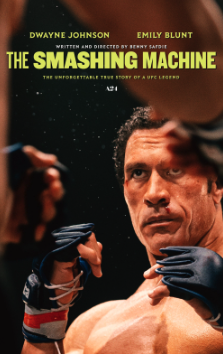
The Smashing Machine - Movie Review

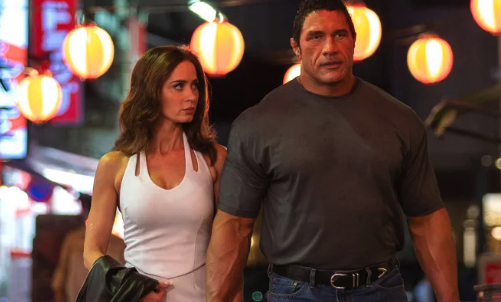
I went into The Smashing Machine wanting to love it. I love Dwayne Johnson. I love that he’s on the board of TKO. I love what he brought to WrestleMania 40. And I love that he’s one of the top five performers on the mic in the history of professional wrestling.

I love the UFC. I love the early days when they would pit fighters of one discipline against those of another just to see who was best. And I love the story of Mark Kerr — a real, tragic figure who helped shape the early years of mixed martial arts. And I love A24. When I saw their logo, I assumed we were about to get a hard-hitting tragedy, something with the emotional depth and quiet power of The Iron Claw — a film that found raw humanity, beauty, and heartbreak in another world of bruised masculinity.

Instead, I got a movie that smothers itself in confusion, misguided musical choices, and an almost pathological focus on addiction at the expense of the real story.

A Soundtrack That Drowns Its Story

The film’s most unforgivable flaw is its music. It’s everywhere, all the time, yet never seems to know why. Sometimes it’s muffled, as though playing from a stereo across the room — and then, without warning, it swells into the full score. There’s no pattern or logic to these transitions, only confusion. At best, it’s distracting; at worst, it undercuts the emotion on screen.

Even the source tracks — often brilliant songs in their own right — are used with baffling tone-deafness. The worst offender is Springsteen’s Jungleland, which plays during the film’s emotional breakup scene. I adore that song; I adore Born to Run. The album is a masterpiece — Thunder Road, Backstreets, Jungleland, the whole thing. But in The Smashing Machine, the use of Jungleland made no sense. Was it supposed to be playing in the room? Was it part of the score? Why this song, in this moment, in the mid-1990s when Springsteen himself was deep into his pop phase (Born in the U.S.A.)? The scene collapses under the weight of its own irony — a masterpiece of romantic yearning misapplied to a moment of domestic chaos.

And forgive me for extending the rant, but Jungleland is the emotional and musical climax of Born to Run — a nearly ten-minute epic that begins with Roy Bittan’s haunting piano, builds through Clarence Clemons’ legendary sax solo, and ends with Springsteen’s wordless cry fading into silence. It’s where all the album’s themes — escape, failure, romantic defiance, the death of youthful dreams — finally collide. It’s a masterpiece of dramatic musical storytelling. To use it as mere breakup wallpaper is criminal.

Then, as if tone-deafness were the guiding aesthetic, the filmmakers chose My Way for the final training montage. A song about self-determination applied to a character who never demonstrates agency or control. Thankfully, they spared us the Sinatra version. There’s no irony in it, no subversion — just confusion.


A Film About Addiction, Not a Fighter

For a movie named The Smashing Machine, it has shockingly little interest in fighting. Yes, there are fight scenes (a bunch of them), and they’re shot well enough — they don’t look like actors fighting (though almost all are close-ups). But the fights feel perfunctory, as if the filmmakers are saying, “We’re showing this because this is a fighting movie.”

In truth, roughly three-quarters of the film’s runtime is consumed by addiction and the decay of a toxic relationship. There’s a potentially great story to tell about a once-great athlete undone by his demons — but this isn’t that story. We never get the sense that Kerr was a prodigy or that he truly loved fighting. He says he feels alive in the ring, but we never really see it.

The tragedy of The Smashing Machine should have been the waste of greatness — the Marcus Dupree arc, the mythic fall of a man who could have been legendary. Instead, we’re left with a story about a guy who fights, takes opioids, fights again, and repeats the cycle, eventually landing in rehab — with a vaguely annoying personality in between. There’s no rise, no fall, no catharsis — just stasis.

Addiction can absolutely be part of a great artist’s story — think Walk the Line or Elvis. Think Ed Wood. Those films show brilliant, singular talents wrestling with their humanity and the consequences of their pain. But Mark Kerr, as portrayed here, is not Bela Lugosi, he’s not Johnny Cash.  And he’s definitely not Elvis. He’s just a guy who fought a bit and got hooked on painkillers. Sad, yes. But not really a story.

Shot Like a Documentary — But Without the Purpose of One

The film is shot in a handheld, vérité style, as though we’re watching a documentary. That might sound intriguing, but it’s mostly just annoying — because it’s not a documentary. The cinematographers seem to want us to feel like we’re on opioids too: everything drifts, lingers, and wobbles without intention. There’s a difference between realism and aimlessness, and this film doesn’t know it. The effect is narcotic, not in an immersive sense, but in a numbing one.

Lost Opportunities

The film flirts with fascinating ideas and then abandons them. The early MMA world — the wild, unsanctioned, pre-corporate days of the sport — could have been a goldmine of myth and cultural texture. The Japan sequences hint at corruption, cultural clashes, cheating, and exploitation, but those threads are dropped almost immediately. What could have been a cross-cultural drama about power and dignity becomes a blur of half-formed notions.

Even the relationship between Kerr and his training partner — the one human dynamic with any spark — is left underdeveloped. It could have grounded the film, shown us a brotherhood at the edge of chaos. Just like Warrior. Or The Fighter. Instead, it’s a whisper amid the noise.

The Performance and the Paradox

Dwayne Johnson gives a remarkable imitation of Kerr — the speech patterns, the hesitant awkwardness, the offbeat rhythm of his personality. He nails it. But what he nails is a man who isn’t very interesting. It’s a technically perfect performance in service of a dramatically hollow script. Portraying dullness accurately does not make a movie compelling.

The Ending That Wasn’t Earned

The film closes with a postscript that reads like it belongs to a different movie. It honors the early pioneers of MMA — the underpaid, overworked fighters who built something lasting — and ends with, “His name is Mark Kerr.” A fine tribute in principle, but the movie itself never supports that idea. We never see Kerr as a builder of anything, never see him contributing to a legacy. There’s nothing poignant about his journey as presented here. The sentiment rings false because the film never earned it. It comes across as the filmmakers wagging a finger at us: “Respect this man.” To which I must respond: help us understand why.

Final Thoughts

By the time the credits rolled, I felt trapped — a prisoner of a film that mistakes mood for meaning, noise for emotion, addiction for depth. I wanted to love it. I wanted it to be the great fighting tragedy of our time. But The Smashing Machine isn’t about greatness lost. It’s about confusion maintained.

And for a full two hours and ten minutes.

And confusion, no matter how beautifully photographed, does not make a film.

“Except One”: Barthes, Paul, and the Myth That Does Not Deceive

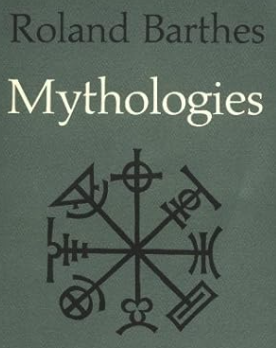
Roland Barthes was right about myth. He saw through the modern world’s favorite sleight of hand—the transformation of meaning into form, of history into nature, of ideology into the obvious. In his collection of essays, Mythologies, his razor-sharp prose cuts through postwar French culture, showing how a magazine cover, a wrestling match, or a bottle of detergent can become a sign stripped of context, bloated with a new, invisible message. “Myth,” he tells us at the outset of his final essay in the volume, “is a type of speech”—a second-order semiological system that turns signs into new signifiers, all the while pretending nothing has changed. Meaning, once rich and historical, is hollowed out and worn like a mask. In this way, myths become engines of alienation—seductive, empty forms that make the artificial appear inevitable.

And Barthes was right. About nearly every myth.

Except one.

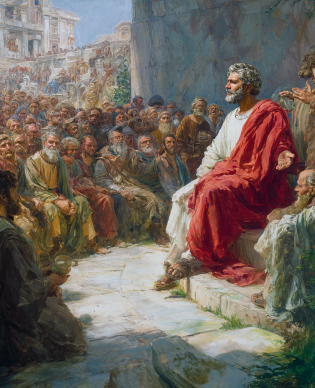
To put it in Pauline terms—if the Apostle Paul were to read Mythologies, he might nod in recognition. The instinct to unmask what is falsely eternal was one he shared. Paul, too, was a hunter of idols, a man who understood how power cloaked itself in piety, how “the elemental spiritual forces of the world”[1] could enslave both Jew and Gentile alike. But Paul’s protest against the world’s empty forms did not leave him in irony. It led him to a singular scandal: the Incarnation.

Where Barthes sees myth as the process of draining meaning into form, Paul sees a mystery—the only case in which form did not destroy meaning but fulfilled it. “Who being in very nature God,” Paul writes, Christ “did not count equality with God something to be used to his own advantage; rather, he made Himself nothing….”[2]. And yet, unlike Barthes’ myth, this kenosis—the self-emptying of Christ—is not an erasure. The Word becomes flesh and dwells among us, not as reduction, but as revelation.

Christ, for Paul, is not a myth in Barthes’ pejorative sense. He is what myth always claimed to be but never was: the Universal made Particular without deceit. This is a descent that does not diminish. The Logos enters history, but does not lose eternity. The form of a servant, the death on a cross—these are not masks concealing power, but windows through which power is redefined. Whereas myth conceals ideology behind a veil of nature, the Incarnation unveils divinity through humility. It is, to borrow from C.S. Lewis, myth become fact—and more than fact, truth offered as communion.

Barthes, to his credit, knew what was at stake. He was not merely denouncing commercials or dissecting sports. He was pointing to the spiritual poverty of a culture that no longer believed in transcendence but continued to borrow its forms. The world of signs had become a museum of empty reliquaries: crosses without crucifixions, freedoms without sacrifice, virtues without God. In such a world, every form becomes suspect, every myth a trap.

But the Apostle Paul would interrupt this funeral procession with a single protest: not this one.

The Incarnation is the only myth that gives back more than it takes, the only form in which meaning overflows rather than evaporates. It does not explain away suffering with a slogan, or transmute sacrifice into sentiment. It endures. It redeems. It is not the ideology of the strong masquerading as nature, but the love of the strong becoming weak—for us.

So yes—Barthes was right about every myth.

Except one.


[1] Galatians 4:3

[2] Philippians 2:6-7

This is part 7 of 7 essays

Cage, Scruton, and the Border of Music

John Cage is one of the most admired—and most misunderstood—figures in 20th-century artistic thought. His most famous work, 4′33″, continues to provoke debate, inspire imitation, and invite reverence. As I argued in the previous article, 4′33″ is sincere, bold, and spiritually loaded. But it is not music. And on this point, philosopher and author, Roger Scruton is both uncompromising and correct.

In his treatise, The Aesthetics of Music, Scruton insists that music is not merely organized sound. Music is not physics. It is not the raw phenomenon of vibrating air molecules. Music, rather, is a tonal and intentional structure, apprehended through imaginative listening informed by culture. Notes become music when they enter into relations—melodic, harmonic, rhythmic—and when those relations mean something to a conscious, culturally shaped mind.

Cage’s 4′33″, while intellectually rich and existentially provocative, offers no such tonal structure, enters into no such relations, and makes no appeal whatsoever to a mind shaped by the Western musical culture. Rather, it asks the listener to hear ambient noise as sound-in-time. There is no pitch to imagine, no tension to follow, no phrase to interpret. What it offers is silence-as-stage, framed by a kind of theatrical gesture in place of music. And that is the crux.

So if Cage’s work is not musical sense, then what is it? It is performative.

Indeed, 4′33″ may belong more properly in the lineage of modern drama than of music. Like Beckett’s Waiting for Godot, it stages emptiness as a condition of life. Like Brecht, it draws attention to the performance itself, rather than the illusion of content. And like Artaud, it demands presence, discomfort, and attention from the audience.

In this light, Peter Szondi, author of Theory of the Modern Drama, would not be out of place studying Cage. Szondi’s theory, after all, centers on how modern drama dissolves traditional plot and character in favor of exposing the crisis of subjectivity. What is 4′33″ but a dramatization of that very crisis?

Cage’s earlier percussion works, while rhythmic and sometimes used in modern dance, occupy a similarly ambiguous position. They are fascinating, sometimes even delightful. But they rarely engage the musical imagination as Scruton defines it. They are choreographic scores more than musical ones.

None of this is to deny Cage’s importance. He expanded our understanding of sound, silence, and listening. He forced us to confront the border between art and non-art. But if we are to preserve any meaningful category called “music,” Cage must remain on its edge, or just outside it.

We may call him a conceptual artist, a philosopher of sound, or even a dramatist of silence. But not a composer of music.

This is part 6 of 7 essays

John Cage and the Costly Silence

When John Cage premiered 4′33″ in 1952—a composition in which not a single note is played—many in the audience thought it was a prank. Some laughed, some walked out. But Cage wasn’t joking. He had just performed what may be the most demanding artistic gesture of the 20th century. And when it was over, he reportedly collapsed in exhaustion.

This is not surprising, if one understands what 4′33″ really is: not an absence of music, but a framing of silence, a radical reorientation of attention. The piece demands the listener hear the coughs, shuffles, and ambient sounds of the concert hall not as intrusions, but as the music itself. It forces composer, performer, and audience alike into a shared vulnerability. There is no melody to hold onto, no harmony to comfort. Only presence, bare and unmediated.  And each “performance” is, obviously, different.

In that sense, 4′33″ is minimalism at its most austere—and most honest. It demonstrates the poetic point made by T.S. Eliot in Little Gidding:

"A condition of complete simplicity (costing not less than everything)."

What Cage offered was not less effort, but more—more courage, more sincerity, more trust in the world to carry meaning without adornment. The exhaustion he felt was the exhaustion of one who had let go of control, who had dared to believe that music could exist without sound, that meaning could emerge from stillness.

Cage was many things—mystic, innovator, trickster—but he was never insincere. 4′33″ is the opposite of a joke. It is a prayer.

And like all true acts of minimalism, it cost him maybe not everything, but much.

This is part 5 of 7 essays

Minimalism and the Condition of Complete Simplicity

In eight words, Eliot offers a phrase that ought to be engraved above the entrance to every gallery of minimalism, every kitchen serving elemental dishes, every manuscript composed of restraint rather than flourish. For what he names is not austerity for its own sake, nor a fetish for sparseness, but a discipline of essence—the rare achievement of clarity without loss, of purity that still carries weight.

This essay is an about-face (or perhaps a complement), and rightly so. For while we have stood with skepticism before the musical altar of Pierre Boulez, whose Bruckner left the listener cold, now we turn toward something subtler, something harder to dismiss. For there are times when what is absent is not a sign of emptiness but of focus. Not every table demands a stew of game meats and root vegetables—a meal fit for a victorious war party of Vikings. Sometimes, what is called for is a consommé—clear, exacting, reduced to its essence. The key is not to confuse the two. Serve one when the other is expected, and disappointment will follow. But when the dish and the occasion align, even minimalism becomes a feast.

The modern eye has learned to spot this ethic in the visual arts, where Gerhard Richter’s “Grey Paintings”—particularly his Six Grey Mirrors at Dia Beacon—line the walls like quiet sentinels. Each surface, nearly uniform at first glance, reveals gradients, textures, and spectral reflections that reward prolonged attention, especially as light changes throughout the day. Gray, Richter once said, “makes no statement”—and yet in that non-statement, we discover the conditions of meaning itself.

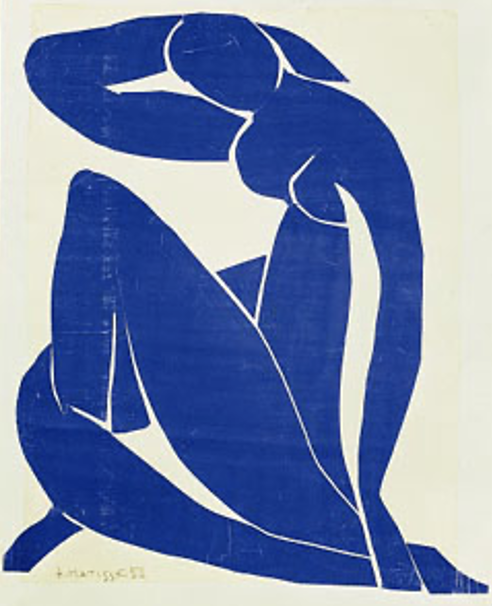
Henri Matisse

Blue Nudes

Or consider Henri Matisse, whose Blue Nudes reduce the human form to bold, curved shapes that carry with them not just visual elegance but emotional immediacy. There is no fuss, no rendering of detail, but the gesture is complete. Though neat, these images are powerful. Matisse once described his desire to create art “devoid of troubling or depressing subject matter... like a good armchair.” What he achieved, at his best, was not comfort but concentration—the beauty of presence without intrusion.

The culinary arts demonstrate this principle well. A perfectly ripe avocado, halved and sliced, served on a non-intrusive white plate, perhaps with just a dusting of sea salt, can be as satisfying—perhaps more so—than a twelve-course extravaganza. The presentation offers no garnish, because no garnish is needed. The color, the oily softness, the faint vegetal perfume—all speak in silence, and what is left out heightens what remains.

This is the minimalist ideal: not silence, but distilled speech. Not an absence of expression, but the refinement of expression into essence.

And so with that, we return to Boulez, this time with a different score in hand. His Anthèmes I, composed for solo violin, is a world apart from his Bruckner. Here, stripped of orchestral density and canonical weight, Boulez operates in a field where minimalism is not sabotage but strategy.

The piece begins with fractured tones, harmonics, isolated gestures that feel almost surgical. The violinist becomes less a performer and more a cartographer of sonic terrain. There are silences—but they are tense, poised, not blank. The listener is asked not to float along but to listen actively, to inhabit each creak of the bow, each whisper of a note. It is, in a sense, music as x-ray—a view into the bone structure of sound.

Does it move the heart as Mahler does? Perhaps not. But that is not its aim. Its success lies in its intensification through limitation, in doing much with little, in letting a single line bear the burden of form.

What minimalism demands—what Eliot understood—is not less effort, but more. Simplicity, if it is to carry meaning, must be intentional, exacting, and often ruthless in what it excludes. It must not simplify complexity into banality, but refine it until only the necessary remains. To do so costs not less than everything: it costs ornament, comfort, and sometimes popularity. But when it succeeds, it allows a clarity of encounter, a distillation of spirit.

It is something “like the stillness between two waves of the sea” as Eliot might say (and did, in fact, say).[1]

Minimalism is not the only path. It is not superior to density, to tradition, to musical or artistic abundance. But it is a path—and at its best, it is a clearing in the forest, a single voice in a cathedral, a plate with one perfect thing upon it.

In the end, it is not a matter of choosing between stew and consomme, between Mahler and Boulez, between abundance and restraint. The greater wisdom lies in knowing when each is called for, and why. For there are days when we need music that remembers the world, and there are days when we need music that forgets it—if only for a moment—to help us see it again, with new eyes so that we can “arrive where we started and know the place for the first time.”[2]


This is Part 4 of 7 Essays


[1] T.S. Eliot, Little Gidding.

[2] T.S. Eliot, Little Gidding.

Boulez and the Disincarnation of Music

Boulez and the Disincarnation of Music

Boulez’s music—and even more so, his conducting—reflects this worldview with eerie precision. His interpretations are crystalline, surgical, thin. Every note is accounted for, every line etched in glass. There is no indulgence, no rubato, no ritual pacing, no metaphysical sweep. The score is treated not as a sacred text but as a matrix. The result is perfectly intelligible but oddly uninhabited.

Read More