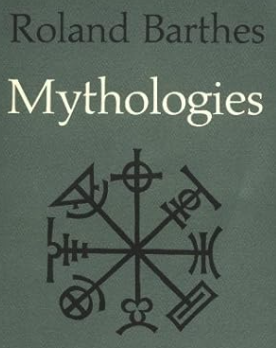
Roland Barthes was right about myth. He saw through the modern world’s favorite sleight of hand—the transformation of meaning into form, of history into nature, of ideology into the obvious. In his collection of essays, Mythologies, his razor-sharp prose cuts through postwar French culture, showing how a magazine cover, a wrestling match, or a bottle of detergent can become a sign stripped of context, bloated with a new, invisible message. “Myth,” he tells us at the outset of his final essay in the volume, “is a type of speech”—a second-order semiological system that turns signs into new signifiers, all the while pretending nothing has changed. Meaning, once rich and historical, is hollowed out and worn like a mask. In this way, myths become engines of alienation—seductive, empty forms that make the artificial appear inevitable.
And Barthes was right. About nearly every myth.
Except one.
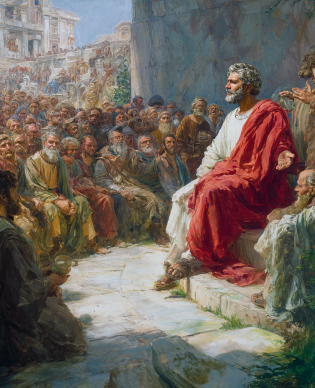
To put it in Pauline terms—if the Apostle Paul were to read Mythologies, he might nod in recognition. The instinct to unmask what is falsely eternal was one he shared. Paul, too, was a hunter of idols, a man who understood how power cloaked itself in piety, how “the elemental spiritual forces of the world”[1] could enslave both Jew and Gentile alike. But Paul’s protest against the world’s empty forms did not leave him in irony. It led him to a singular scandal: the Incarnation.
Where Barthes sees myth as the process of draining meaning into form, Paul sees a mystery—the only case in which form did not destroy meaning but fulfilled it. “Who being in very nature God,” Paul writes, Christ “did not count equality with God something to be used to his own advantage; rather, he made Himself nothing….”[2]. And yet, unlike Barthes’ myth, this kenosis—the self-emptying of Christ—is not an erasure. The Word becomes flesh and dwells among us, not as reduction, but as revelation.
Christ, for Paul, is not a myth in Barthes’ pejorative sense. He is what myth always claimed to be but never was: the Universal made Particular without deceit. This is a descent that does not diminish. The Logos enters history, but does not lose eternity. The form of a servant, the death on a cross—these are not masks concealing power, but windows through which power is redefined. Whereas myth conceals ideology behind a veil of nature, the Incarnation unveils divinity through humility. It is, to borrow from C.S. Lewis, myth become fact—and more than fact, truth offered as communion.
Barthes, to his credit, knew what was at stake. He was not merely denouncing commercials or dissecting sports. He was pointing to the spiritual poverty of a culture that no longer believed in transcendence but continued to borrow its forms. The world of signs had become a museum of empty reliquaries: crosses without crucifixions, freedoms without sacrifice, virtues without God. In such a world, every form becomes suspect, every myth a trap.
But the Apostle Paul would interrupt this funeral procession with a single protest: not this one.
The Incarnation is the only myth that gives back more than it takes, the only form in which meaning overflows rather than evaporates. It does not explain away suffering with a slogan, or transmute sacrifice into sentiment. It endures. It redeems. It is not the ideology of the strong masquerading as nature, but the love of the strong becoming weak—for us.
So yes—Barthes was right about every myth.
Except one.
[1] Galatians 4:3
[2] Philippians 2:6-7
This is part 7 of 7 essays