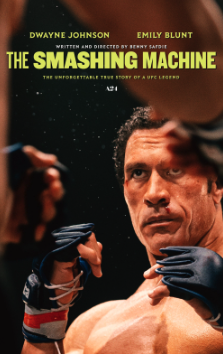
I went into The Smashing Machine wanting to love it. I love Dwayne Johnson. I love that he’s on the board of TKO. I love what he brought to WrestleMania 40. And I love that he’s one of the top five performers on the mic in the history of professional wrestling.
I love the UFC. I love the early days when they would pit fighters of one discipline against those of another just to see who was best. And I love the story of Mark Kerr — a real, tragic figure who helped shape the early years of mixed martial arts. And I love A24. When I saw their logo, I assumed we were about to get a hard-hitting tragedy, something with the emotional depth and quiet power of The Iron Claw — a film that found raw humanity, beauty, and heartbreak in another world of bruised masculinity.
Instead, I got a movie that smothers itself in confusion, misguided musical choices, and an almost pathological focus on addiction at the expense of the real story.
A Soundtrack That Drowns Its Story
The film’s most unforgivable flaw is its music. It’s everywhere, all the time, yet never seems to know why. Sometimes it’s muffled, as though playing from a stereo across the room — and then, without warning, it swells into the full score. There’s no pattern or logic to these transitions, only confusion. At best, it’s distracting; at worst, it undercuts the emotion on screen.
Even the source tracks — often brilliant songs in their own right — are used with baffling tone-deafness. The worst offender is Springsteen’s Jungleland, which plays during the film’s emotional breakup scene. I adore that song; I adore Born to Run. The album is a masterpiece — Thunder Road, Backstreets, Jungleland, the whole thing. But in The Smashing Machine, the use of Jungleland made no sense. Was it supposed to be playing in the room? Was it part of the score? Why this song, in this moment, in the mid-1990s when Springsteen himself was deep into his pop phase (Born in the U.S.A.)? The scene collapses under the weight of its own irony — a masterpiece of romantic yearning misapplied to a moment of domestic chaos.
And forgive me for extending the rant, but Jungleland is the emotional and musical climax of Born to Run — a nearly ten-minute epic that begins with Roy Bittan’s haunting piano, builds through Clarence Clemons’ legendary sax solo, and ends with Springsteen’s wordless cry fading into silence. It’s where all the album’s themes — escape, failure, romantic defiance, the death of youthful dreams — finally collide. It’s a masterpiece of dramatic musical storytelling. To use it as mere breakup wallpaper is criminal.
Then, as if tone-deafness were the guiding aesthetic, the filmmakers chose My Way for the final training montage. A song about self-determination applied to a character who never demonstrates agency or control. Thankfully, they spared us the Sinatra version. There’s no irony in it, no subversion — just confusion.
A Film About Addiction, Not a Fighter
For a movie named The Smashing Machine, it has shockingly little interest in fighting. Yes, there are fight scenes (a bunch of them), and they’re shot well enough — they don’t look like actors fighting (though almost all are close-ups). But the fights feel perfunctory, as if the filmmakers are saying, “We’re showing this because this is a fighting movie.”
In truth, roughly three-quarters of the film’s runtime is consumed by addiction and the decay of a toxic relationship. There’s a potentially great story to tell about a once-great athlete undone by his demons — but this isn’t that story. We never get the sense that Kerr was a prodigy or that he truly loved fighting. He says he feels alive in the ring, but we never really see it.
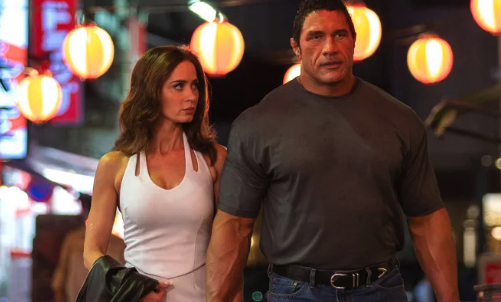
The tragedy of The Smashing Machine should have been the waste of greatness — the Marcus Dupree arc, the mythic fall of a man who could have been legendary. Instead, we’re left with a story about a guy who fights, takes opioids, fights again, and repeats the cycle, eventually landing in rehab — with a vaguely annoying personality in between. There’s no rise, no fall, no catharsis — just stasis.
Addiction can absolutely be part of a great artist’s story — think Walk the Line or Elvis. Think Ed Wood. Those films show brilliant, singular talents wrestling with their humanity and the consequences of their pain. But Mark Kerr, as portrayed here, is not Bela Lugosi, he’s not Johnny Cash. And he’s definitely not Elvis. He’s just a guy who fought a bit and got hooked on painkillers. Sad, yes. But not really a story.
Shot Like a Documentary — But Without the Purpose of One
The film is shot in a handheld, vérité style, as though we’re watching a documentary. That might sound intriguing, but it’s mostly just annoying — because it’s not a documentary. The cinematographers seem to want us to feel like we’re on opioids too: everything drifts, lingers, and wobbles without intention. There’s a difference between realism and aimlessness, and this film doesn’t know it. The effect is narcotic, not in an immersive sense, but in a numbing one.
Lost Opportunities
The film flirts with fascinating ideas and then abandons them. The early MMA world — the wild, unsanctioned, pre-corporate days of the sport — could have been a goldmine of myth and cultural texture. The Japan sequences hint at corruption, cultural clashes, cheating, and exploitation, but those threads are dropped almost immediately. What could have been a cross-cultural drama about power and dignity becomes a blur of half-formed notions.
Even the relationship between Kerr and his training partner — the one human dynamic with any spark — is left underdeveloped. It could have grounded the film, shown us a brotherhood at the edge of chaos. Just like Warrior. Or The Fighter. Instead, it’s a whisper amid the noise.
The Performance and the Paradox
Dwayne Johnson gives a remarkable imitation of Kerr — the speech patterns, the hesitant awkwardness, the offbeat rhythm of his personality. He nails it. But what he nails is a man who isn’t very interesting. It’s a technically perfect performance in service of a dramatically hollow script. Portraying dullness accurately does not make a movie compelling.
The Ending That Wasn’t Earned
The film closes with a postscript that reads like it belongs to a different movie. It honors the early pioneers of MMA — the underpaid, overworked fighters who built something lasting — and ends with, “His name is Mark Kerr.” A fine tribute in principle, but the movie itself never supports that idea. We never see Kerr as a builder of anything, never see him contributing to a legacy. There’s nothing poignant about his journey as presented here. The sentiment rings false because the film never earned it. It comes across as the filmmakers wagging a finger at us: “Respect this man.” To which I must respond: help us understand why.
Final Thoughts
By the time the credits rolled, I felt trapped — a prisoner of a film that mistakes mood for meaning, noise for emotion, addiction for depth. I wanted to love it. I wanted it to be the great fighting tragedy of our time. But The Smashing Machine isn’t about greatness lost. It’s about confusion maintained.
And for a full two hours and ten minutes.
And confusion, no matter how beautifully photographed, does not make a film.