The Work Is Not Finished: T. S. Eliot, Cats, the Gospel, and Dramatic Completion
Some works of art are finished. Others are complete. The two are not the same thing. A painting may dry. A manuscript may be published. A symphony may receive its premiere. A poet may revise a final line, put down his pencil, and leave the work to posterity. In one sense, the act of creation has ended.
Yet the greatest works refuse to remain where their creators left them. They continue to seek voices, bodies, audiences, collaborators, interpreters, and hosts. They are finished as artifacts but unfinished as dramatic realities: not incomplete, but still mysteriously unfinished. Their texts may be settled, yet their meanings remain capable of becoming newly present in encounters their creators could neither control nor foresee.
The artistic life of T. S. Eliot offers an extraordinary illustration of this distinction. Eliot’s major poetic achievement culminates in Four Quartets, which remains, in my judgment—for now—the supreme work of contemplative poetry in the English language.
Yet his career and output cannot be understood simply as an ascent toward that solitary summit. Running beside it is another movement: a gradual progression from the written poem toward communal voice, embodied action, theatrical space, and dramatic encounter. Eliot began as the revolutionary poet of fractured modern consciousness, but he increasingly turned toward the theater. His artistic journey might therefore be described not merely as a passage from poetry to drama, but as the long effort of poetry to discover its own dramatic completion.
The story begins, paradoxically yet also predictably, with tradition. Eliot was among the most deeply backward-looking of modern intellectuals. He had absorbed the classical inheritance, Christian theology, the metaphysical poets, the French symbolists, and the whole structure of European literary history. Dante and Shakespeare stood above everyone else in his imaginative universe. He knew the tradition not as a scholar knows an inventory but as a poet knows a language: from within, through use, memory, imitation, resistance, and love.
Yet this immersion did not make Eliot an antiquarian. He lived in the twentieth century and could not honestly pretend otherwise. He had to create The Waste Land, a poem that appeared revolutionary because it refused to imitate the surface forms of the past while drawing relentlessly upon their deepest resources. Eliot’s “new poetry” sounded new precisely because he knew how much of the old world had become inaccessible to modern consciousness. Fragmentation was not a novelty imposed upon the material; it was the form demanded by the reality he perceived.
For Eliot, then, tradition was not a collection of monuments arranged behind glass. It was a living order in which past and present continually encountered and altered one another. The new work entered the tradition, and by entering it changed how the older works were perceived. This is the argument in his essay “Tradition and the Individual Talent,” but it is also the drama of Eliot’s own artistic life and, indeed, his artistic afterlife. Eliot could not have anticipated that one of the most consequential demonstrations of his theory would occur decades later, when another artist would take up some of his seemingly minor poems and enable the world not merely to read them differently, but finally to encounter them. For the first time.
Before that could happen, however, Eliot himself moved steadily toward drama. The movement begins at the beginning. “The Love Song of J. Alfred Prufrock” is called a song, but it is also a dramatic monologue, and it belongs to the tradition most powerfully developed in English by Robert Browning. Browning had already demonstrated that poetry could approach theater through the creation of a speaker whose words disclose more than the speaker consciously intends. His dramatic monologues do not merely describe character; they enact the event of character revealing itself.
Eliot inherits this form but makes it more fractured and interior. Prufrock is not simply a fictional speaker delivering an account of himself. His consciousness becomes a performance, complete with hesitations, revisions, anticipated judgments, imagined audiences, abrupt changes of register, and an almost unbearable awareness of himself as both performer and spectator. The poem must therefore be performed, even when read alone. Its rhythms, pauses, tonal evasions, whispered ironies, and sudden intensities cannot be apprehended fully as silent propositions. Prufrock does not merely have thoughts. He stages them.
The polyphony of The Waste Land carries this dramatic tendency further. The poem is not a play in the conventional sense, but it is populated by multiple voices that interrupt, answer, haunt, and displace one another. The solitary lyric speaker has fractured into something theatrical. Browning gives us dramatic speakers; Eliot increasingly gives us dramatic communities, although the community of The Waste Land is broken, dispersed, and populated by the living and the dead. The poem does not merely report a crisis of consciousness. It stages the crisis of consciousness within a civilization whose inherited words remain present even when their meanings can no longer be securely inhabited.
The movement toward communal dramatic form becomes more explicit in The Rock, the 1934 pageant written to support church building in the Diocese of London. There is an inviting parallel here between Eliot’s participation in actual church building and the later imaginative building that occurs in Little Gidding, but that temptation must be resisted for another occasion. What matters here is that Eliot did not write the whole pageant. He wrote the choruses, and those choruses have outlived the immediate occasion that produced them.
But what, exactly, are the Choruses from The Rock? They are poetry, certainly, but “poetry” does not fully describe them. They resemble liturgy without becoming liturgy, an oratorio without music, a cantata without a score, a sermon divided among communal voices, and a Greek chorus summoned into industrial modernity. They are public and prophetic, intellectual and incantatory. They are intended not merely to be read but to be spoken, heard, received, and answered by a gathered community.
They ask questions that do not remain safely on the page: “Where is the Life we have lost in living?” The line is philosophical, but its mode is dramatic. It does not simply offer an idea for private contemplation. It addresses a people, and it challenges a people. It gains force because it comes not only from a solitary poet but through a chorus whose voice is somehow both within and beyond the community it addresses.
The instability of the form is therefore not a defect. It is the source of its fascination. The Choruses reach beyond literature toward an Event. The Choruses want voices. They want bodies. They want space, silence, response, and communal recognition. They are not “incomplete” in the ordinary sense; Eliot gave them a finished verbal form. Yet they remain “unfinished” because they contain within themselves a desire for completion through performance. They wait for others to breathe through them.
Peter Brook gives us a way of naming that desire. In his astonishing short treatise The Empty Space, Brook repeatedly distinguishes living theater from theater that merely reproduces established effects. The theater becomes alive not when the text is dutifully preserved, nor when a production jarringly announces its originality, but when something actually happens between performers and audience. Theater is not merely an artifact displayed before observers. It is an encounter whose truth depends upon presence, attention, risk, response, and the possibility that the work may become newly real.
Brook’s famous bare-stage formulation reduces theater to a person crossing an empty space while another person watches. Yet the space is not truly empty once the crossing and the watching begin. It becomes charged by relation. Brook describes those rare moments in which a scattered collection of spectators becomes, for a time, an audience: not merely people occupying adjacent seats, but a body gathered into a shared apprehension. The empty space makes possible a living presence.
Emptiness, in this sense, is not an aesthetic fetish. It is a clearing away of whatever prevents the word, the body, the silence, or the action from becoming fully perceptible. Theater exists so that what has not yet been said may breathe. John Cage made a comparable discovery in music. In 4′33″, silence is not the absence of a performance but the condition under which the sounds already inhabiting the room can finally be heard. What appeared empty becomes full because attention has changed. (See my essay, John Cage and the Costly Silence, to further explore this topic)
Read in this light, Eliot’s movement toward theater seems less like a late-career change of genre than the unfolding of a tendency already present within his poetry; an end that was already in his beginning. The poet increasingly desired not only to address a reader but to gather a community. Poetry wanted to become presence.
Murder in the Cathedral (1935) represents the most natural continuation of the Choruses. It combines poetic speech, chorus, ritual, history, theological action, and a setting already saturated with memory. It is not merely a play about Thomas Becket’s death. It creates a ceremonial encounter with temptation, obedience, violence, pride, martyrdom, and the dangerous possibility of desiring even the right act for the wrong reason. The chorus does not decorate the action. It receives, fears, interprets, resists, and finally bears it. Its members are not passive witnesses to the martyrdom; their consciousness becomes one of the locations in which the meaning of the martyrdom must occur.
Eliot’s subsequent plays move nearer to recognizable theatrical forms. The Family Reunion places the Eumenides inside a modern English family drama, binding Greek tragedy, psychological guilt, drawing-room convention, and Christian vocation into an unstable but fascinating whole. The play sometimes seems to be testing whether ancient structures of pursuit, inherited guilt, and expiation can still inhabit modern domestic life without becoming mere literary allusion.
The Cocktail Party begins almost as social comedy and gradually opens into questions of vocation, sacrifice, sainthood, and the limits of ordinary happiness. The drawing room becomes metaphysical without ceasing to be a drawing room. The Confidential Clerk and The Elder Statesman continue Eliot’s exploration of identity, family, reconciliation, concealment, memory, and moral transformation. His dramatic works thus move from the overtly ritual and poetic toward forms that appear increasingly conventional.
That conventionality should not be dismissed as artistic retreat. Eliot was moving into a craft whose demands were new to him. He had mastered poetic form, but theater required another kind of intelligence: knowledge of actors, rooms, pacing, gesture, rehearsal, audience, and the strange resistance of embodied performance. A poet may control the words on a page with extraordinary precision. But a playwright must give those words away to bodies, voices, directors, designers, technicians, and an audience whose response cannot be finally predicted.
Eliot needed, in a sense, to move backward through dramatic forms before he could move forward within them. His plays are therefore interesting not only as successes or failures but as experiments. One senses a poet attempting to learn the grammar of embodiment. Had he lived longer, written more plays, and acquired still more experience of rehearsal and production, it is impossible to know where that apprenticeship might have led.
Brook possessed this grammar through an ocean of theatrical observation that Eliot did not. He had watched the same production succeed in one social setting and fail in another. He had seen Shakespeare live and die under different conditions. He knew that the work performed before an audience was not identical to the script and that the performance was not simply delivered by actors to passive recipients. It arose within a changing field of attention, trust, resistance, expectation, social history, and response.
Eliot understood much of this imaginatively, and he loved the theater, but he did not possess Brook’s lifetime of directorial knowledge. Had Eliot written a brief treatise on theatrical life after decades in rehearsal rooms, it might not have resembled The Empty Space in style. Eliot’s prose was often more tentative, recursive, and qualifying than Brook’s directorly concision. Yet one suspects that he would have recognized Brook’s deepest convictions. Both men were profoundly traditional and genuinely revolutionary because neither mistook the preservation of inherited surfaces for fidelity to tradition. Each asked how an old truth might become alive now.
Then comes one of the great and beautiful ironies in modern artistic history. Eliot spent decades attempting to recover poetic drama for modernity. He died in 1965, leaving behind a finished body of poetry and a series of plays. His career appeared complete. Yet one of the fullest dramatic realizations of his poetic imagination had not occurred.
Sometime in the 1970s, Andrew Lloyd Webber heard something. He already had Joseph and the Amazing Technicolor Dreamcoat, Jesus Christ Superstar, and Evita behind him or underway as evidence of an extraordinary musical-theater imagination. Yet in Eliot’s apparently modest collection Old Possum’s Book of Practical Cats, he heard something else.
Again, this Event Happened: Andrew Lloyd Webber heard something in Old Possum.
The verb matters. Webber did not merely seize upon a marketable literary property, nor did he only add melodies to familiar poems, though at the most literal level he certainly did set Eliot’s words to music. He heard within those poems a latent theatrical world. He heard possibilities. The poems wanted voices and bodies. They wanted movement, character, rhythm, costume, light, space, and communal delight. What had existed as playful verse could become a society, a ritual, a gathering, an election, an act of judgment, and an unexpected story of degradation, recognition, forgiveness, and ascent.
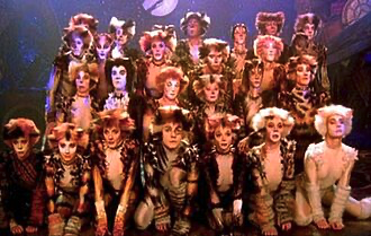
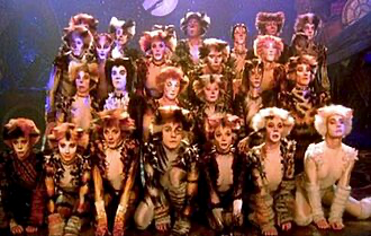
Cat’s cast
The original theatrical production was itself profoundly collaborative. Cats brought Eliot’s verse together with Webber’s music, Trevor Nunn’s direction, Gillian Lynne’s choreography, John Napier’s design, David Hersey’s lighting, and the embodied work of a company of performers. No single participant contained the finished work. Eliot supplied its verbal world, but even the phrase “Eliot supplied the libretto” is misleadingly simple. He did not write a conventional libretto for the musical. He left poems, fragments, rhythms, characters, names, gestures of imagination, and unrealized dramatic possibilities. Webber, Nunn, Lynne, Napier, the performers, and eventually the audience did not merely illustrate those materials. They discovered the dramatic Event latent within them.
The history of dramatic art repeatedly unsettles the Romantic picture of the solitary genius creating in heroic isolation. Shakespeare needed actors, a company, a theater, and an audience. The Ballets Russes became a catalytic space in which Sergei Diaghilev brought together figures such as Stravinsky, Picasso, Jean Cocteau, and great choreographers and dancers, enabling works to emerge that belonged fully to none of them alone. Stravinsky and Balanchine later formed one of the great creative partnerships of the twentieth century, not because music became dance or dance became music, but because each artist heard possibilities in the other’s work that neither medium could disclose by itself.
Such collaborations do not diminish authorship. They reveal its dramatic nature. A great collaborator does not disappear into another artist’s intention, nor simply impose an alien conception upon inherited material. The collaborator listens, answers, transforms, and is transformed. Authorship becomes encounter.
One can therefore make a provocative claim while preserving the necessary distinctions. Cats is not Eliot’s greatest poem. Four Quartets remains the summit of his contemplative poetic imagination. But Cats may well be the fullest dramatic realization of Eliot’s poetic imagination.
In Cats, Eliot’s language ceased merely to be read. It was spoken, sung, danced, costumed, illuminated, embodied, and, most importantly, shared. The poems entered theatrical time. Characters who had existed in verbal sketches—and vividly, as I can attest as a father, in the minds of daughters who had heard them read aloud—acquired physical bearing, vocal identity, gesture, weight, rhythm, social relation, and vivid presence. The work became simultaneously rough and holy, in Brook’s terms, as well as comic and elegiac, childish and ancient, playful and poignant.
We rightly call it musical theater, but Cats also resembles pageant, revue, ballet, ritual, character study, music hall, circus, and liturgy without resting securely in any of them. Its generic instability recalls the Choruses from The Rock, although its theatrical means are entirely different. Eliot’s poetry had again exceeded a single form, but this time a great musical-theater imagination and an extraordinary company of collaborators allowed that instability to become a living dramatic whole. In Brook’s deepest sense, Cats became an Event.
This does not mean that Cats solved a problem Eliot had failed to solve, as though Webber had repaired an incomplete artistic career. It means that one artist recognized possibilities in another artist’s work that could emerge only through collaboration across time. Eliot had argued that the individual talent enters a living tradition in which old and new works mutually reorder one another. Webber’s reception of Eliot enacted that principle.
After Cats, Old Possum’s Book of Practical Cats could no longer be heard in quite the same way. The later work altered the reception of the earlier one, while Eliot’s poetry gave Webber a verbal, rhythmic, and imaginative world unlike any conventional musical-theater source. Eliot became, posthumously and unexpectedly, a collaborator in one of the most successful works in theatrical history.
Valerie Eliot appears to have understood the generosity and significance of this collaboration. Her delight in the musical’s success was not merely financial, although its success produced abundant financial rewards, and there is nothing regrettable about that. In accepting the Tony Award on behalf of the work, she spoke briefly but as one who recognized that her husband’s poetry had not been diminished by its passage into popular musical theater. It had been released into another life.
She knew Eliot’s love of the theater. One imagines that he might have been surprised by Cats, bemused by parts of it, attentive to its departures from his own dramatic practice, and perhaps uncertain at first about the spectacle surrounding his poems. Yet it is difficult to believe that he would not also have been delighted, and I believe profoundly moved, to encounter a theater filled with people receiving his language through music, movement, humor, grief, and communal recognition. He had spent much of his career asking whether poetry could again become public, communal, and dramatic. Cats answered him from beyond his lifetime. And the answer is a resounding yes.
Yet even Cats was not completed by its creators or by its original company in 1981. A living dramatic work is not finally exhausted by its premiere. Its subsequent productions are not necessarily replicas of an authoritative first Event. At their best, they become further Events in the life of the work. We have seen this with Les Misérables. We may yet see it with Hamilton. A work can be firmly established and still remain dramatically unfinished.
I encountered such an Event in Houston. My family attended a Saturday performance of the touring production of Cats. When they returned home, they did not offer an ordinary recommendation. They said, in effect: You have to go tomorrow. This is the most astonishing performance we have ever heard (and rest assured, my family has heard a great deal). I went the next day because their response had the character of testimony.
They were right.
Keri René Fuller, then performing Grizabella in the North American tour, sang “Memory.” A studio performance of her singing the song remains available, and the comments responding to it repeatedly express the sense that something exceptional occurred in her interpretation. But the studio performance, remarkable as it is, cannot reproduce what happened in the theater that afternoon.
“Memory” did not merely survive as a famous song dutifully reproduced in another city. It happened. The work had been performed thousands of times. The melody was familiar. The theatrical context was established. The audience knew, at least generally, what was coming. Yet Fuller made the song present as though its truth had not been exhausted by repetition. Indeed, she delivered a performance that felt less like a superior interpretation of a song we knew than an encounter with a song we had never heard.
For those few minutes, “Memory” ceased to be repertoire and became confession. One did not merely admire the song or the singer. One encountered Grizabella: her shame, exhausted dignity, remembered beauty, longing for recognition, and final willingness to ask for touch. The familiar theatrical number became an immediate human claim upon the audience.
This is the paradox of living performance: fidelity does not require stasis. The notes remain substantially the same, the words remain the same, and the character remains recognizable, yet the encounter can become radically new. Nothing in the artifact has changed; everything in the Event has changed. A new Event has happened.
Brook insists that theater is perishable, written on the wind because its life exists in the moment of performance and reception. The very fragility of that encounter makes renewal possible. A performance that attempts only to preserve an earlier success becomes deadly, in Brook’s language. A performance that seeks novelty for its own sake becomes merely fashionable. But a performance that enters the work truthfully can permit an old song to become new. Authentic novelty arises not from the artist’s determination to be unprecedented but from the discovery of some portion of reality that has ceased to be seen.
This is why the artistic work should not be imagined as an inert object passed intact from creator to consumer. Nicholas Wolterstorff’s insistence that “art is something we do” points toward a more adequate account. A work exists not only as text, score, canvas, or recorded object, but within practices of making, performing, attending, remembering, interpreting, receiving, and responding. The dramatic arts make this especially visible, but the principle reaches beyond conventional theater.
Shakespeare is not finished. Mahler is not finished. Beckett is not finished. Van Gogh is not finished. Their works are not incomplete, and they are not available for arbitrary alteration in the name of personal relevance. Yet their lives cannot be reduced to their originating artifacts. They continue to become present within new acts of faithful attention.
The distinction between the work and the Event is important. The work is not identical to any one encounter. Cats is not exhausted by its original production, nor by the Houston performance, nor by any future revival. The work possesses a durable form that makes fidelity possible. Yet that form also possesses the capacity to host Events. A truthful performance does not replace the work. It allows the work to become newly present.
He Makes All Things New
The claim can be extended further, and here it must be stated boldly but carefully: the Gospels are not finished.
This does not mean that revelation is incomplete, that the scriptural texts await improvement, or that later performers are licensed to rewrite the Gospel according to their preferences. The written Gospels are complete. Yet they were never intended merely to remain as completed verbal objects. They are to become vehicles for the Gospel itself. The written Gospel is complete; the proclaimed Gospel is always becoming present.
The Gospels (the writings) and the Gospel (the kerygma, the message) seek proclamation, hearing, remembrance, embodiment, judgment, repentance, mercy, and life. They seek voices and congregations. They seek the preacher, the reader, the actor, the choir, the disciple, and the stranger. They seek meals, baptisms, funerals, weddings, hospital rooms, street corners, sanctuaries, and ordinary acts of forgiveness. Every faithful proclamation is not another Gospel, but another dramatic realization of the same Gospel.
A story from the long ministry of Dr. Edwin H. Young at Second Baptist Church in Houston is worth remembering. When Young preached his “sermon in view of a call,” as lifelong Southern Baptists like to say, the congregation expected an accomplished, carefully structured demonstration of his preaching, which it would then have the duty and privilege to evaluate. A polished sermon was part of the expected form of the occasion.
Instead, as the story has been remembered and retold, Dr. Young rose, walked to the pulpit.
Then, he paused.
He looked out to and upon the congregation.
Then he recited John 3:16.
Then he sat down.
In silence.
This act, which I have encountered through recollection and retelling, was not an evasion of a sermon. Rather, it was sermon concentrated into dramatic form—the sermon toward which every other Christian sermon must finally point.
Anyone, Young later explained, could deliver at least one polished sermon. But if the church was not committed to living John 3:16, and if he was not committed to living John 3:16 as its pastor, then they were not meant to undertake ministry together.
The pause, the verse, and the decision to sit down transformed a familiar text into an Event. The congregation was not asked merely whether it admired his preaching. It was asked whether pastor and people would inhabit the same Gospel. The apparent absence of a conventional sermon opened a space in which the essential question could finally be heard.
The ministry that followed, lasting for decades and extending through Houston and far beyond it, became an exposition of that brief dramatic act.
The sermon was not finished when Young sat down. It awaited years of action, failure, fidelity, preaching, mission, institution-building, pastoral care, and communal life. John 3:16 was not altered. It was made newly present as a vocation.
The Biblical archetype of such dramatic recognition is Emmaus (Luke 24:13-35). The travelers already “know” the reported events. They have heard about the crucifixion, the empty tomb, and the testimony of others. The information is present, but recognition has not yet occurred.
Then, a stranger joins them, interprets what they already know, walks with them, and finally breaks bread.
Their eyes are opened.
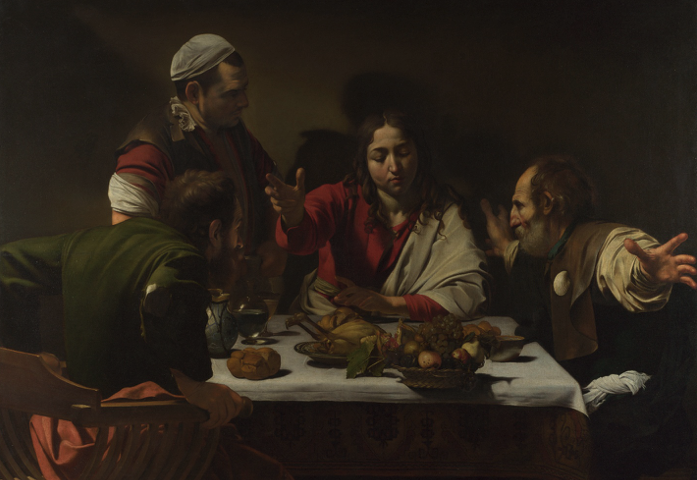
Supper at Emmaus - Caravaggio
Nothing is added to the identity of the risen Christ, yet everything changes in their encounter with Him. They arrive at what they had already been told and know it for the first time.
Here Eliot, Brook, Webber, Fuller, Young, and the travelers to Emmaus unexpectedly converge. Eliot’s poetry increasingly sought communal embodiment. Brook argued that theater must become a living encounter rather than a repetition of accepted effects. Andrew Lloyd Webber heard musical and theatrical possibility within poems that T.S, Eliot had left behind. Fuller made a song performed countless times become an Event of astonishment. Young took one of the most familiar verses in Christianity and allowed its familiarity to be interrupted by silence, concentration, and action. At Emmaus, remembered words become presence and recognition. In each case, the work is not merely transmitted. It becomes present.
This illuminates the larger promise of dramatic aesthetics. Drama need not be understood merely as one genre among the arts. This is an idea I have been working with: drama names the event-structure in which all art reaches toward its fullest disclosure. The arts retain their distinct media: painting remains painting, music remains music, poetry remains poetry, liturgy remains liturgy, and theater remains theater. Yet each becomes fully alive in encounter. Presence meets attention. Form meets freedom. The received work meets a new historical moment. Something appears, and recognition becomes possible.
How do we get there? Hospitality is essential to this process. The host does not invent the truth offered to the guest, nor does the host simply abandon the guest to an unstructured experience. The host prepares a space, receives what arrives, directs attention, preserves freedom, and allows what is already present to become shared. Eliot hosts Dante and Shakespeare. Brook hosts actors, texts, spaces, and audiences. Webber hosts Eliot. Fuller hosts Grizabella. Young hosts John 3:16. At Emmaus, the apparent guest becomes the host at the breaking of the bread.
The work itself may also become a host. It receives different generations without surrendering its identity. It creates a space in which they can meet the dead, the absent, the forgotten, the suffering, and the hoped-for. It does not demand mere repetition but invites faithful participation. It remains stable enough to be recognized and living enough to recognize us. That is why Peter Brook always returns to Shakespeare.
Eliot’s own account of tradition prepares us for this conclusion. Tradition is not repetition, because the new work changes the order into which it enters. Nor is performance repetition, because the new encounter reveals possibilities within the work that earlier encounters may not have exhausted. The performer does not own the work but hosts it. The audience does not passively consume the work but participates in its becoming present. The greatest works survive not because they remain untouched, but because they continue to find faithful forms of embodiment.

T.S. Eliot outside a theatre where his play “The Elder Statesman” was being performed, 1958.
Perhaps this is why the greatest works never become obsolete. They are not preserved merely because museums, publishers, orchestras, churches, universities, or theatrical institutions protect them, valuable though such protection may be. They endure because each generation discovers that they still possess the capacity to become present. Their authority lies not in their antiquity but in their inexhaustibility. They continue to reveal truths that no single performance, reading, interpretation, or historical moment can fully contain.
That is what happened when Andrew Lloyd Webber heard drama within Eliot’s poems. It happened again when Keri René Fuller sang “Memory” in Houston. It happened when Ed Young stood before a congregation, spoke John 3:16, and sat down. The work remained itself, but those who encountered it were invited to know it anew.
And of course, T.S. Eliot had already given us the language for this mystery:
We shall not cease from exploration
And the end of all our exploring
Will be to arrive where we started
And know the place for the first time.