Still Looking, Still Believing
For years, I have had a problem with “I Still Haven’t Found What I’m Looking For.”
Not a musical problem. I have always thought it a compelling song, and an indispensable part of the magnificent Side A opening of The Joshua Tree. My problem was theological, and perhaps even a little cranky.
And I was not alone. I remember Ben Young once playing an excerpt from the song during a Sunday evening service at Second Baptist Church, using it as an example of doubt, angst, anxiety—the restless and perhaps fruitless search for something that remains unfound.
That reading made perfect sense to me. In fact, it more or less confirmed what had always bothered me about the song.
What do you mean, you still haven’t found what you’re looking for?
To make matters still more difficult, the song is not being sung by someone who has never encountered Christianity, or who stands outside the faith wondering whether there might be something to it. Bono tells us quite plainly:
“I believe in the Kingdom Come.”
That is not the language of inquiry. It is the language of affirmation, the language of the Creed: I believe. And what follows is more explicit still. Christ bore the cross and the singer’s shame; his bonds have been broken. These are not vague gestures toward transcendence. They are Christian claims.
So what, then, exactly, has he not found?
The lawyer in all of us should press him on that question.
Christianity, after all, does not regard doubt as a virtue in itself. Our culture sometimes speaks as though the doubter must necessarily be more interesting, more sophisticated, perhaps even more authentic than one who simply believes. The New Testament is considerably less sentimental about it. James describes the one who doubts as “like a wave of the sea driven and tossed by the wind.” Doubt can divide us against ourselves.
And yet the New Testament—and, indeed, all of Scripture—is populated by actual human beings, whose faith is rarely so tidy.
One of my favorite examples occurs in the ninth chapter of Mark. Jesus has just expressed exasperation at unbelief: “O faithless generation, how long shall I be with you?” A father has brought his tormented son to Jesus after the disciples have failed to heal him. Jesus tells the father that all things are possible to the one who believes.
The father responds with one of the most honest prayers in Scripture:
“Lord, I believe; help thou my unbelief.”
And Jesus does not condemn him. He heals his son.
That strange little exchange helps me hear “I Still Haven’t Found What I’m Looking For” differently. Doubt does not thereby become a virtue. But perhaps faith and incompleteness are not opposites either. The father does not say, I do not believe. He says something much stranger, much more recognizable, and much more human: Lord, I believe. Help the part of me that does not.
I now think Bono is doing something similar.
He believes in the Kingdom Come. He believes in the Cross. He believes his bonds have been broken. And still he has not found what he is looking for.
That tension—belief without completion—is not merely in the words. It is in the music.
Listen to the end of the chorus in the original recording. The final line does not give us the sense of melodic arrival we might expect. The voice rises into the harmony rather than settling comfortably at its bottom. Harmonically, nothing is crudely “wrong” or left dangling. The song can continue. But melodically, and almost rhetorically, we are denied complete resolution.
The song ends its sentence without ending its search.
That upward movement matters. A descending melody arriving firmly home might almost contradict the words: I still haven’t found what I’m looking for—and here we are.
Instead, the melody reaches.
The singer has not arrived.
For years, that bothered me. Perhaps it was supposed to.
The Gospel Version
But then there is the gospel version.
On Rattle and Hum, U2 performs the song with the New Voices of Freedom, a Harlem gospel choir, and something remarkable happens. It is unmistakably the same song. The words have not acquired some new dictionary meaning; the underlying musical structure remains recognizable.
And yet the song means something different.
Or, perhaps more precisely, the singers are doing something different with it.
The original recording gives us a solitary voice surrounded by enormous musical space. Even with the band beneath him, Bono sounds like a distinctly modern, individual consciousness making its confession into the distance. He has climbed. He has run. He has crawled. He has kissed. He has burned. He has spoken with angels and held the hand of a devil. And he believes.
And still.
He has not found what he is looking for.
But watch what happens when the choir takes possession of the song. That same “still” is lifted out of the private anguish of the individual seeker and placed inside a community that is moving inexorably forward.
Voices answer voices. Bodies move. The music gathers force. What sounded searching now sounds expectant. What sounded anguished becomes, astonishingly, triumphant.
The search has not disappeared. But the anxiety about the search has. Feel that?
A Pilgrimage
The word I keep returning to is pilgrimage.
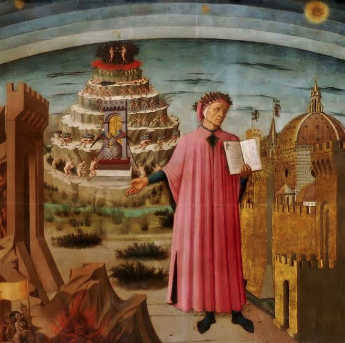
Dante and the Mountain of Purgatory: the pilgrim has not arrived, but he knows where he is going.
A pilgrim, by definition, has not arrived. If he had arrived, he would no longer be a pilgrim. There is still a road beneath his feet, still a distance between where he stands and the place for which he longs.
But pilgrimage is not wandering.
The distinction matters. The wanderer does not know where the road ends. The pilgrim does. We know where we are going. We know where we will arrive. We are on the journey, but the end is certain. And we make the journey in community.
That, to me, is what the gospel choir does to “I Still Haven’t Found What I’m Looking For.”
The original can sound like: I believe—but where is all this going?
The gospel version sounds more like: We believe. We are not there yet. Come with us.
There is a very old Christian grammar behind that distinction. Augustine's restless heart is restless precisely because it has an object: “our heart is restless until it rests in you.” Dante's pilgrim has not reached the final vision, but he is being led toward it, first by Virgil, then Beatrice and finally Bernard of Clairvaux. Bunyan's Christian has not reached the Celestial City, but the City is there. And the old American wayfaring stranger travels through a world of woe not in search of a possible home, but on the way to one.
The road will be difficult. The traveler may falter. He may even lose sight for a time of where he is going. But the destination does not depend upon his ability to see it.
That long tradition changes the meaning of still.
The upwardness of Bono's melody can consequently acquire another meaning as well. In the original, it can sound unresolved, interrogative, searching. Sung within the grammar of gospel (and, indeed, the Gospel), that same upward gesture can become aspiration, expectation, even praise. It reaches upward because that is where it is going.
The destination is not in doubt. Only the journey remains.
And perhaps that is why the gospel version has gradually helped me make peace with the original. Christianity does not require us to pretend that arrival has already occurred. The Kingdom has come, and we still pray that the Kingdom will come. Christ has broken the bonds, and creation still groans. We believe, and we ask God to help our unbelief.
There is an enormous difference between not knowing what you are looking for and not yet possessing fully what you know you are looking for.
The gospel choir knows the difference.
Then I Started Reading the Song…
Somewhere in thinking about the theology and music of “I Still Haven’t Found,” however, I began paying closer attention to the words themselves.
And I discovered—or perhaps simply noticed—Bono the poet.
I have climbed the highest mountains
I have run through the fields
Only to be with you
I have run, I have crawled
I have scaled these city walls
Only to be with you
But I still haven’t found what I’m looking for
I have kissed honeyed lips
Felt the healing in her fingertips
It burned like fire
This burning desire
I have spoke with the tongue of angels
I have held the hand of a devil
It was warm in the night
I was cold as a stone
But I still haven’t found
What I’m looking for
I believe in the Kingdom Come
Then all the colours will bleed into one
Bleed into one
But yes, I’m still running
You broke the bonds and you loosed the chains
Carried the cross of my shame
You know I believe it
But I still haven’t found
What I’m looking for
Consider the images he gives us:
Mountains. Fields. Honeyed lips. Fingertips. Fire. Angels. A devil. Kingdom. Colors. Cross. Shame. Bonds.
What is missing is almost as interesting as what is present.
There is virtually no connective tissue.
Bono does not pedantically explain that he has sought transcendence through striving and sensual fulfillment through earthly love, only to discover that neither has exhausted the deepest longing of the human person. That would be an essay.
Instead, he announces:
“I have kissed honey lips.”
It is wonderfully jarring.
A moment ago we were climbing mountains, running through fields, scaling walls and suddenly we have a mouth. Honey. A kiss.
Then fingertips. Healing. Desire burning like fire.
Without warning we have been plunged into garlic and sapphires in the mud, the gritty sensuality of earthly life. Bono does not argue that sensual desire participates somehow in the larger human hunger for transcendence. He gives us lips, fingers and fire and allows us to feel why it might.
Then angels.
Then a devil.
Then, just as abruptly:
“I believe in the Kingdom Come.”
This is good poetry. It trusts images enough not to explain them. And if you feel like a punching bag after reading those images in rapid succession, that’s good.
And one image in particular has always stayed with me:
“All the colors will bleed into one.”
It is an extraordinary image of reconciliation. Distinctions remain visible long enough to be called and experienced as colors, and yet somehow their separateness is then overcome. The many become one. Even the verb bleed carries more than one possibility: colors run together, certainly, but in a song that will shortly invoke the Cross, blood is never very far away.
I cannot hear the image without at least an echo of Paul: “There is neither Jew nor Greek, there is neither bond nor free, there is neither male nor female.” Paul does not mean that human particularity is abolished; the astonishing claim is that these distinctions though real no longer divide those who have become “one in Christ Jesus.” Bono's colors need not disappear in order to become one. They bleed into one another. It is not difficult to see in that image a visual analogue to Paul's theological one: distinction somehow surviving within reconciliation.
Whether Bono intended that particular Pauline echo hardly matters to the poem. The image is capacious enough to contain it.
And Bono does not explain any of this. The image appears. Years later, as good poets often do, he returns to colors.
After the Flood
“Beautiful Day” is another song that can suffer from being too familiar. Its chorus is so immediately accessible, so obviously uplifting, that it is easy not to notice how strange the lyric actually is.
Images arrive, disappear, and are replaced by other images. The song moves geographically and visually, almost cinematically. We see roads, deserts, canyons, seas, fires and—one of my favorites—oil fields at first light. China appears. Bedouin fires appear. Tuna fleets appear. Nature untouched and human civilization occupy the same enormous field of vision.
See the world in green and blue
See China right in front of you
See the canyons broken by cloud
See the tuna fleets clearing the sea out
See the Bedouin fires at night
See the oil fields at first light
And then, suddenly:
“See the dove with a leaf in her mouth.”
Ok, now Genesis has entered the song.
There is no announcement, no warning. Bono does not tell us that he is about to make a biblical allusion. He does not explain Noah, the Flood, judgment, covenant or restoration. He does not even need to say rainbow.
Instead:
“After the flood all the colors came out.”
There are the colors again.
But notice what has happened.
In “I Still Haven’t Found,” the colors “bleed into one.” In “Beautiful Day,” after the flood, all the colors “came out.”
These are not the same image. In the first, redemption seems to move toward a new unity: the colors cease standing apart and bleed into one another. In the second, redemption produces an explosion of distinction. After judgment and catastrophe, the world becomes colorful again. Creation reappears in all its multiplicity.
Unity in one song. Particularity in another.
I do not think we need to reconcile them (hold that thought….). In fact, explaining them too completely would diminish them. That is precisely what poetry permits that exposition does not.
What matters is that Bono seems instinctively to reach for color when ultimate things are happening. Spiritual reality becomes visible. Redemption does something to the world, and suddenly color behaves differently—and beautifully.
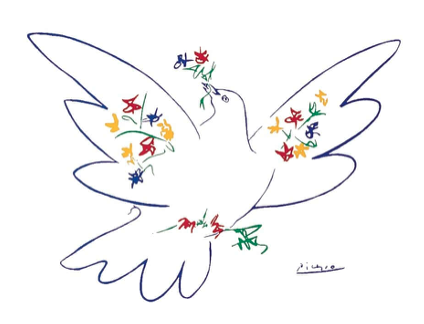
Picasso's famous dove illuminates the thought perfectly: dove, leaf, rainbow—the elemental signs of peace and covenant compressed into an image simple enough for a child and capacious enough to carry a world.
And now we have William Blake
And somewhere around this point another poet becomes difficult for me not to hear.
William Blake.
Blake does not give us much connective tissue either.
He gives us a lamb.
In “The Lamb,” from Songs of Innocence, the vocabulary is almost childishly simple: a little lamb, a child, a stream, a meadow, wool, a tender voice. The child asks the lamb who made it and then supplies the answer. The Creator is himself called a Lamb; he became a child; child and lamb alike are called by his name.
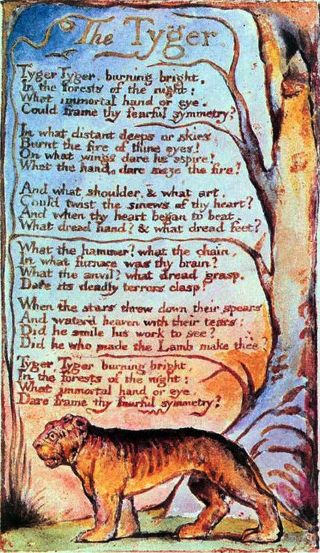
In “The Tyger,” from Songs of Experience, the nursery simplicity of the language remains, but almost everything else has changed. Fire replaces meadow. Furnace, hammer, anvil and chain replace soft wool. The question of creation becomes terrible rather than comforting.
And then Blake asks:
“Did he who made the Lamb make thee?”
That is nearly the whole argument.
Blake does not set before us an exposition of the theological problem of reconciling innocence, terror, beauty and creation. Rather, he gives us a vision: he puts the Lamb and the Tyger before us and makes us look at them together.
The vocabulary can be almost childishly simple.
Lamb. Child. Tyger. Fire. Cloud. Garden. Chimney. London. Heaven. Hell.
The words are simple. But the imaginative relations among them are enormous.
That is what increasingly strikes me about Bono at his best.
Kingdom. Colors. Blood. Cross. Shame. Flood. Dove. Leaf.
None is an unusual word. Most could be understood by a child. Yet put them next to one another and Genesis, Noah, covenant, Calvary, eschatology, and personal confession suddenly inhabit the same imaginative space.
And neither Blake nor Bono is especially interested in explaining how we got from one to the next. As poets, they do something similar. They place things together and let the connection appear.
That is one reason the “honey lips” matter so much to me. Blake would understand perfectly well why a poem concerned with spiritual longing might suddenly put us inside the body. Flesh and spirit are not neatly separated territories in Blake's imagination (or in Christian theology). Desire can be dangerous, glorious, sweet, fallen, creative, destructive and revelatory, sometimes almost simultaneously.
Bono's song behaves similarly. He has climbed the mountain. He has kissed the woman. He has spoken with angels. He has held hands with the devil.
He also believes in the Kingdom.
And he still has not arrived.
The contraries remain alive. And that may be the most Blakean thing about the song.
Blake does not resolve contraries by elimination. He allows their energies to remain in tension. Innocence and experience illuminate each other, and vice versa. Heaven and hell can become terrifyingly close. The Lamb does not make the Tyger disappear.
Likewise Bono can say I believe and I still haven't found without treating either statement as fraudulent.
Perhaps that is why the later connection with Blake seems so natural.
Songs of Innocence and Songs of Experience
Eventually U2 stopped making us guess. In 2014 the band released Songs of Innocence. In 2017 came Songs of Experience. Blake's titles had become U2's titles.
But I don't hear those records as the moment Bono discovered William Blake. I hear them almost as a recognition: Bono had finally placed Blake's name upon imaginative territory in which he had been living for a very long time.
And the collaboration—if I can call a conversation across two centuries a collaboration—is magnificent.
Because U2 does not merely borrow two clever titles. Rather, they inhabit the Blakean categories.
Songs of Innocence is filled with origins: Dublin, childhood, first encounters with music, first encounters with violence, first encounters with love and loss, and the very Irish experience of being simultaneously inside and outside. And above everything is Bono's mother, Iris, whose death when he was fourteen left an absence that runs through his life and art.
But innocence is also musical innocence: the astonishing moment when somebody else's music enters your life and permanently changes what you think the world can sound like.
The Clash are there.
The Beach Boys are there.
And don't even get me started on the Ramones.
I have written enough about the Ramones and their place in music history. Suffice it to say that Joey Ramone's presence in U2's story is not ornamental nostalgia. These are the voices through which four boys on the North Side of Dublin began discovering the possibility of becoming U2.
That makes the Blake titles profound rather than merely literary. Innocence is not stupidity. It is the world when it is first received. Experience is what happens when we return to that world carrying everything that has happened since.
A mother dies.
A boy grows older.
A band forms.
Records are heard.
Faith is tested.
Success arrives.
Bodies age.
Friends disappear.
The world becomes more complex and richer. Or, as Eliot puts it so perfectly in East Coker:
“As we grow older
The world becomes stranger, the pattern more complicated
Of dead and living.”
And then, just a few lines later:
“Not the intense moment
Isolated, with no before and after,
But a lifetime burning in every moment”
That is exactly it. The experienced artist and reflective human being eventually turns around and discovers that his own voice has always contained other voices.
Which takes us, unexpectedly, back to Harlem and the gospel choir.
The solitary singer was never entirely solitary. None of us is. We receive words, melodies, images, gestures and faith from others. We inherit them, inhabit them, add our own voices, and hand them onward. Blake knew that innocence and experience are not simply chronological stages in which one replaces the other. We carry both.
U2 knows it too.
Still…
And so, after all these years, I am less annoyed by “I Still Haven’t Found What I’m Looking For.”
Not entirely unannoyed. James remains in the New Testament. Christianity cannot make perpetual uncertainty into a spiritual achievement. It makes claims upon us to which the answer is not perhaps, but Credo.
I believe.
Bono says it:
“I believe in the Kingdom Come.”
But Mark 9 remains in the New Testament too:
“Lord, I believe; help thou my unbelief.”
Christ does not condemn the father for the contradiction in his prayer. He receives the faith that is there and meets him in what remains incomplete.
Perhaps that is what I had missed in Bono’s refrain.
The Christian life is neither wandering toward an unknown destination nor pretending that the journey is already over. It is pilgrimage.
We know where we are going. We know where we will arrive. The road remains beneath our feet, but the end is certain—and we do not walk alone.