September 7, 2026 Buddy Holly’s 90th birthday
History is now…
We are born with the dead:
See, they return, and bring us with them.
The moment of the rose and the moment of the yew-tree
Are of equal duration. A people without history
Is not redeemed from time, for history is a pattern
Of timeless moments. So, while the light fails
On a winter's afternoon, in a secluded chapel
History is now and England.
T.S. Eliot, Little Gidding
There are places where history seems almost obliged to happen. New York has the scale for it. London has the buildings. Memphis has The River and New Orleans has everything. Even before you know exactly what happened in such places, they seem prepared to receive history, as though history had sent word ahead and somebody had put out chairs.
Clovis, New Mexico, is not like that. My hometown, Farwell, Texas, eight miles east of Clovis, is even less so.
Clovis sits out on the High Plains eight miles from the Texas line, in country where distance is less something measured than something lived with. Lubbock is about a hundred miles away across the Llano Estacado, and for most of that drive the land gives you very little assistance in thinking that you are going anywhere important.
Towns announce themselves with water towers, grain elevators, radio towers, a little accumulation of commerce beside the highway. The sky is extravagant because the earth is not. You can watch weather coming from a very long way off.
I grew up in that country, near the Texas-New Mexico state line—though, just for clarity, we were in Texas. Clovis was simply Clovis, but it was also in New Mexico and one hour earlier.
My grandparents knew Norman Petty. My brother later worked for him at KTQM, the FM radio station Petty owned, and my brothers and I have recently come together to remember him affectionately as “Jump Suit Norman,” because Norman wore jumpsuits. This was not an observation about a figure in the history of recorded music. It was an observation about Norman, the man who lived in Clovis.
Only later does one understand that this is how history usually appears to the people standing closest to it.
T. S. Eliot understood something like this in Little Gidding. His language is much larger than anything I mean to claim for Clovis—he is writing about time, history, death and redemption—but the image he gives us is wonderfully modest but devastatingly effective: light failing on a winter afternoon in a secluded chapel. Then the astonishing declaration, “History is now and England.”
Notice how little has to happen. The light changes. An old place grows dark. Yet somehow Eliot makes us feel that history is not safely behind us, arranged neatly but with sterility into dates and monuments, gathering dust on bookshelves. Rather, History is present in the room. The dead are there; the living are there; the past has not disappeared but gathered itself into this particular moment, in this particular place.
***
Norman and Vy Petty had a recording studio in Clovis, and in the middle 1950s a skinny young man from Lubbock named Buddy Holly began driving west along Highway 84: past Littlefield, Waylon Jennings’s hometown; past Sudan; past Muleshoe; past Farwell; over the railroad tracks, across the state line, into the previous hour and then eight more miles to Clovis.
There is a temptation, knowing what came afterward, to turn this trip into pilgrimage: Holly crossing the Plains toward destiny, the little studio waiting for him like some appointed place. But of course neither Holly nor Petty could have experienced it that way. Holly was trying to make records. Petty was trying to make good ones. They were musicians and craftsmen at work.
And yet something happened in that room.
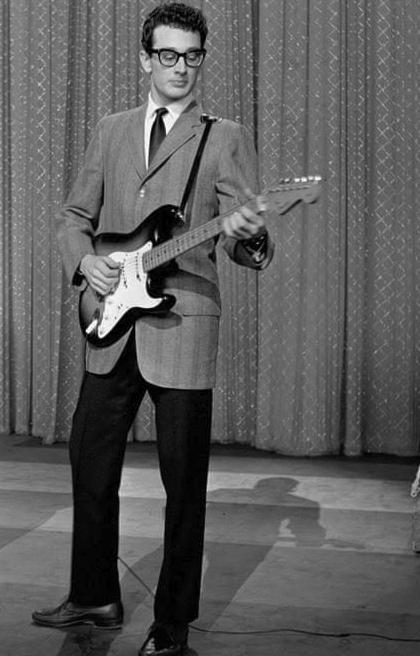
It is difficult now to hear Buddy Holly with innocent ears. He has been absorbed too completely into the language of popular music. We hear the glasses, the Stratocaster, the hiccup in the voice, the Crickets, the two-minute songs, the astonishing combination of country directness and rhythmic urgency, and we hear “Buddy Holly.”
But there was no Buddy Holly before Buddy Holly. There were antecedents everywhere. We know the story of American music, and it is always worth recalling: hillbilly and country, western swing, Hank Williams, Bob Wills—still the king—rhythm and blues, rockabilly, Elvis, Bo Diddley, the whole racial and regional collision out of which rock and roll emerged. Antecedents do not explain the Event. They explain how an Event became possible.
Then, in 1957, lightning struck.
What Norman Petty did was give the lightning a room.
That distinction matters because popular music history, like most history, likes stars better than rooms. We rightly remember the person standing at the microphone or beating the piano into submission. Producers, engineers, accompanists, studios, towns, local scenes and accidents of geography recede behind the finished record. But recording is an art of attention, and Petty understood possibilities in the studio that Holly needed. A record did not merely have to reproduce what musicians sounded like standing together in a room. The room itself could participate. Voices could be doubled. Sounds could be placed and altered. A song could be assembled into something that had never existed in precisely that form until the tape ran.
Holly brought the thing that could not be taught. Norman Petty heard what might be done with it.
And sometimes Petty stepped out from behind the glass and played. That's Norman at the piano on “Rave On.”
This is one reason their story resists the easy mythology of the solitary genius. Holly was unmistakably the Event. Twenty-two years is all he got, and the amount of musical possibility compressed into those years remains almost absurd.
But the Event happened somewhere, and for a decisive period that somewhere was Norman Petty’s studio in Clovis, New Mexico.
***
The music went out from there. It traveled farther than anybody in that room could possibly have imagined—across America, certainly, but across the Atlantic too, where young musicians in England encountered Holly. John Lennon and Paul McCartney listened. The name “Beatles” itself carries the famous echo of the Crickets: an insect, a band, a little joke embedded inside what would become the most consequential name in the history of popular music.
More important was the model. Young men could form a group, play guitars, write their own songs, sing them and make records that bore the identity of the group itself.
This sounds ordinary only because Buddy Holly and the Crickets helped make it ordinary.
The line of descent becomes harder to draw after that, which is where cultural history becomes more interesting and also more dangerous. Influence is not chemistry. We cannot place records into test tubes and determine exactly how much Buddy Holly is present in the Ramones, or the Clash, or Elvis Costello, or the Police, or U2. But, where musicians themselves tell us what they heard, we should trust the evidence.
We know, for instance, that U2 understood the Ramones and the Clash as tectonic events in their own formation. Those doors opened and four boys from the North Side of Dublin discovered that they too could burst through. But it would be too easy to convert that fact into a neat chain—Holly begat the Ramones, the Ramones begat U2—and call the matter settled. Culture rarely travels so obediently.
Something more interesting may have happened: by the middle 1970s, rock music had accumulated weight. It had acquired virtuosity, spectacle, enormous amplifiers, enormous arenas, enormous songs, concept albums, and musicians capable of playing things that a kid with a cheap guitar could reasonably conclude he would never be able to play. Much of this music was magnificent. But magnificence has its own dangers. An art form born partly from the discovery that young people could make an astonishing noise with very little had begun requiring rather a lot.
Then somebody counted to four.
Dee Dee Ramone’s machine-gun count-off—one, two, three, four—became almost a manifesto. Enough waiting. Enough elaboration. Four numbers and go.
The Ramones did not need to be consciously returning to Buddy Holly for something Holly had understood to become audible again: brevity, melody, youth, nerve, energy, the guitar band as a self-contained little unit, the possibility that a song could arrive, accomplish its business and leave before anyone had time to admire the furniture.
Give us two minutes, eight seconds and we will change the world.
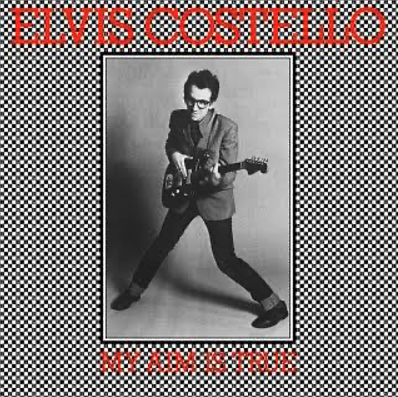
Punk tore something down, certainly, but tearing down can also uncover foundations. Through the opening came the Clash and then an extraordinary generation of musicians who understood that simplicity need not mean stupidity, that energy and simplicity could itself be a form of intelligence. The Police came through that opening. U2 came through it. The Go-Go’s came through it. Elvis Costello, looking suspiciously like Holly in those glasses, turned concision into something acidic and literate and new.
We should resist oversimplification here. Buddy Holly did not “cause” punk or new wave. History does not work that way, not exactly. As Eliot notes in Gerontion, history has “many cunning passages, contrived corridors.” Cultural history may be more cunning still.
But this we can say with confidence: when rock and roll needed to remember how little it required in order to become dangerous again, it recovered possibilities that had been there almost from the beginning, some of them caught on tape in a little studio in Clovis, New Mexico.
And then the history begins doing something peculiar. It starts coming home.
***
Joe Ely belongs in this story because Joe Ely belongs to that country. His music contains the problem with musical categories: rock and country and honky-tonk and Mexican music and folk traditions meeting in a sound that makes considerably more geographical sense than it does taxonomic sense.
The High Plains do not recognize the bins in a record store. Sounds travel along highways, across borders, through AM radio at night, out of bars and dance halls and car windows. Lubbock produced Holly, but it also produced Ely, and when Ely encountered the Clash there was a mutual recognition across a distance that looked much greater on a map than it sounded through an amplifier.
There is a story of Ely and members of the Clash going out after a Lubbock show to Buddy Holly’s grave and drinking beer there all night long. It is difficult to improve upon that image, and probably unwise to try, though someday I would like to write a poem about it: English punks and a West Texas musician standing in a Lubbock cemetery, drinking beer near the grave of a young man who had been dead for roughly two decades. They were not there because Holly had invented rock and roll or punk. They were there because they knew where they were.
The distinction is everything.
A grave is where cultural history becomes embarrassingly physical. Influence, lineage, genre, modernity: these are useful words until you are standing above the ground where somebody was buried. Then there is dirt. A name. Dates. Twenty-two years between them. The music has traveled around the world while the body has remained in Lubbock.
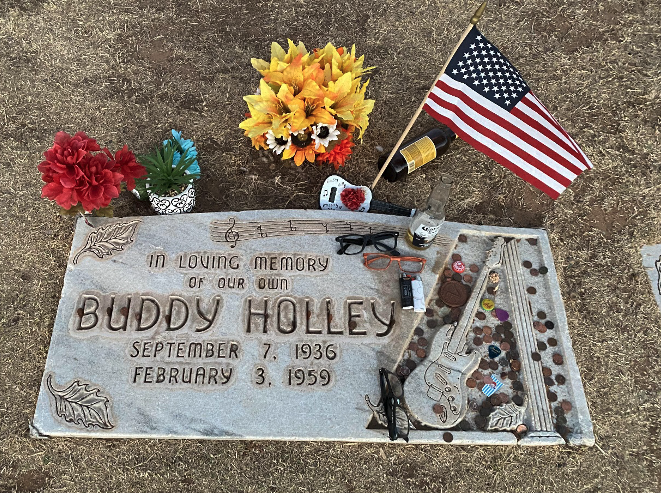
Eliot, especially in East Coker, keeps bringing history back to this physical fact. Generations dance and work and build; feet keep time upon the earth; eventually the earth receives them. Eating and drinking belong to the pattern too. So do dirt and death. The rhythm somehow survives the dancers. That is harder to forget standing at a grave. Buddy Holly’s music had already crossed an ocean and helped call other music into being; Buddy Holly had gone nowhere. He was here. Well, at least his body was here.
Perhaps that is why the beer matters when Joe Ely and the Clash gather there. Flowers would have made the scene too reverent. Beer is right for it: earth, beer, young men and music, the living standing around the grave of another young man. The pilgrimage remains human-sized.
***
Paul McCartney provides an even stranger return. As boys in Liverpool, he and John Lennon listened to Buddy Holly. The music made in Clovis crossed an ocean and entered the imagination of musicians who would transform popular culture on a scale that makes almost every attempt at description sound inflated, even when it is accurate.
Decades later, after the Beatles had broken up and John Lennon was dead, rumors began circulating that Paul McCartney had been seen in Clovis. This was a part of the country already somewhat famous for UFO sightings, and to me the McCartney reports belonged to roughly the same category.
People around Clovis and along the Texas state line would say they had seen him.
Paul McCartney. In Clovis.
This sounded exactly like the kind of story people tell in small towns, a story requiring only one person to have a cousin whose friend worked somewhere and was absolutely certain that the man who came in Tuesday afternoon was Paul McCartney.
The claim defeated itself by being too interesting. Why would Paul McCartney be in Clovis, New Mexico? You might as well have seen Mick Jagger at Allsup’s.
But the stories persisted, they did not fade away.
And eventually we learned that they were true.
We learned, too, that McCartney had acquired the publishing rights to Holly’s songs.
There is something unbearably satisfying about this. The circle is complete. The young man from Lubbock goes to Clovis. The records made there travel outward. They reach Liverpool. Liverpool sends the music back transformed beyond recognition, amplified until the whole world hears it. The boy who heard Buddy Holly becomes Paul McCartney. And then Paul McCartney, of all people, comes back to Clovis.
There is also a story from 2008, about McCartney and Nancy Shevell were driving west across the country in a Ford Bronco. They came through Amarillo and continued west toward Tucumcari on the old Route 66, crossing some of the most emphatic beef country on earth. During the stop at the Ambassador Hotel in Amarillo, McCartney, a vegetarian of many years, needed something to eat. There is something wonderfully gentle in the encounter: McCartney asking, without apparently expecting the landscape to rearrange itself around him, whether vegetarian food might be found for him there; and the people receiving the request with the equally ordinary grace of hospitality—of course, we can find you something. (It helps, no doubt, to be Paul McCartney).
***
And this is where the enormous history and the ordinary history become difficult to separate. My grandparents knew Norman Petty. My brother worked for him. Jump Suit Norman.
That nickname may tell us something important that the monuments cannot. History eventually turns people into nouns: Buddy Holly, Norman Petty, Paul McCartney. Their names begin to signify movements, eras, innovations, influences.
But nobody actually lives as a noun. Norman Petty got up in the morning and brushed his teeth. He went to work. He wore jumpsuits. He ate Mexican food at El Monterey. People in Clovis knew him. Employees had conversations with him about ordinary things. Friends saw him socially. Whatever his place in the history of recorded music, there were people for whom he remained simply Norman.
And Buddy left him. That too belongs in the story. The relationship ended with disagreements and grievances, as relationships in the music business often do. Holly moved toward New York and toward whatever was coming next. Petty remained in Clovis. Then, not very long afterward, on a frozen night in Iowa, Buddy Holly got onto an airplane and disappeared into history.
Norman went on living.
There is something almost cruel about the difference. Holly’s death fixed him forever at twenty-two: glasses, guitar, youth, possibility. Petty had to age. He had to continue working, make other records, run businesses, own a radio station, wear his jumpsuits, encounter people at the grocery store, become somebody’s employer, somebody’s friend, somebody my grandparents knew.
Holly became a symbol, a legend, a myth. Norman remained a man.
And still the records kept going.
That may finally be what is most interesting. We are accustomed to imagining cultural history as though it occurs on a stage, with the important people illuminated and everybody else in darkness. But perhaps history is more like radio waves crossing the High Plains at night. Something happens in one place and moves invisibly outward. Someone hears it a hundred miles away. Someone else hears that person years later across an ocean. A boy starts a band because another band made starting one seem possible. A rhythm disappears and returns. A song gets covered. A guitar sound waits twenty years and becomes useful again. Nobody possesses the whole sequence.
Eventually people begin traveling backward along the signal. Joe Ely and the Clash go to the cemetery. Paul McCartney comes to Clovis. And those of us who grew up nearby eventually discover that some of the stories we heard as children, stories that seemed no more consequential than any other local story, belonged to the history of the world.
***
There is a temptation to call such places sacred ground. And they are, though not because the ground itself possesses magic. They are sacred because human beings did things there, and human beings later remember what happened there. A cemetery in Lubbock becomes different because somebody lies beneath it. A building in Clovis becomes different because certain sounds were once made inside it. The road between Lubbock and Clovis becomes different when we know who traveled it and what was carried.
But, yet, even so, sacred ground remains ground.
That may be the mercy in it. The High Plains are largely indifferent to our categories of importance, and they have always been like this. Buffalo once covered these plains and were slaughtered almost out of existence. The Comanche world that depended upon them was violently broken. Cattlemen came behind them, and then fences; farmers broke the earth, and then came drought and dust. Through all of it the wind never stopped.
The elevators still stand beside the railroad tracks. The highway still runs straight toward the horizon. Now there are turbines turning in that old wind. Data centers are coming. They too will look permanent - for a while. People go to work at the radio station. Somebody sees a man at a restaurant who looks like Paul McCartney and tells somebody else, who does not believe him. Somewhere a Buddy Holly song is playing.
We know now what the people in Norman Petty’s studio could not have known: that the young man at the microphone had almost no time. We know that the records would cross oceans. We know that boys in Liverpool would listen. We know who Waylon Jennings (who did not get on the plane) would become. We know that rock and roll would grow enormous, then rebel against its own enormity, and that generations of musicians would repeatedly rediscover the exhilarating proposition that a guitar, a melody, a beat and two minutes might be enough. We know that musicians would someday travel to Lubbock and drink beer beside Buddy Holly’s grave. We know that Paul McCartney would come back across the Plains toward the place where some of the sounds that changed his life had been made.
Norman Petty could not know any of that. He turned the knobs. Buddy sang. The tape rolled.
Outside, the Plains went on being the Plains.
The world changed in a little room in Clovis, New Mexico. And Clovis remained Clovis.
Coda: Not Fade Away
There is one last performance worth watching. In a 1988 PBS tribute to Buddy Holly, Kris Kristofferson introduces Joe Ely with reverence, calling him a personal hero and describing him as the keeper of the faith of Buddy Holly’s legacy. It is a beautiful phrase, particularly coming from Kristofferson, another Texan (born in Brownsville) who knows something about songs traveling farther than the people who wrote them ever could. But then the introduction ends and the metaphor becomes almost literal: Ely walks out to sing with the Crickets themselves.
And what song could they possibly play but Not Fade Away?
There is almost too much history standing on that stage. Joe Ely, the Lubbock musician who drank beer with the Clash at Buddy Holly’s grave, is singing Buddy’s song with the men who played beside Buddy when he was alive. The young man who should be standing at the microphone is absent, and everyone knows why. But the Crickets are there. Ely is there. Kris Kristofferson is there. The beat is there. Even the Rolling Stones, who previously covered Not Fade Away are figuratively there.
Three decades after Holly carried that rhythm into Norman Petty’s studio in Clovis, Joe Ely leans into the microphone, the Crickets begin to play, and for a few minutes the whole cunning passage of history gathers itself into the present.
Not fade away.