In Praise of the First Dropkick
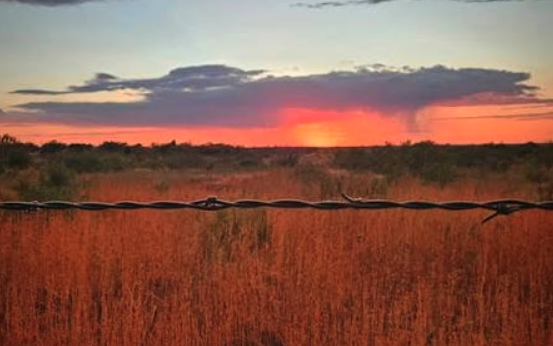
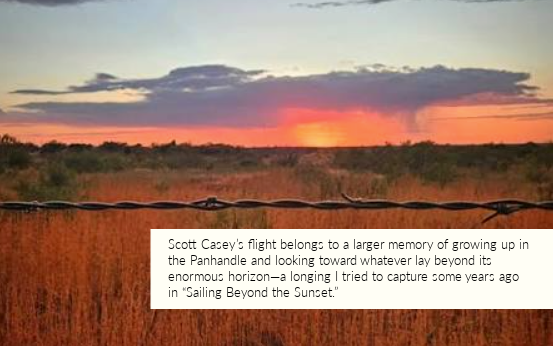
I began watching wrestling from Amarillo in the summer of 1975, although “Amarillo” is not quite precise. I watched Amarillo wrestling from farther out in the Panhandle, in a small town on the Texas–New Mexico border, surrounded by distance, wind and sky.
The distance mattered. This was before cable television dissolved the boundaries between one place and another, before videotapes circulated widely, before the internet made almost every surviving match immediately available to everyone. The wrestling on our television came from Amarillo, and for a child watching out in the Panhandle, that wrestling was not one regional variation among many. It was wrestling itself.
Only much later, through adult reading and research, did I learn to speak about wrestling “styles”—the technical traditions, booking philosophies and dramatic grammars of the various territories. In 1975, I did not know that Amarillo wrestling occupied a country somewhere between the scientific and the brawling.
I knew only what I saw: there were holds. Headlocks, hammerlocks and armbars dominated the early part of a match. Then there were the finishing holds: abdominal stretches, camel clutches, full nelsons and, above all others, spinning toe holds. These mattered. A man caught in one did not merely wait for the next part of the performance to begin. He struggled against it. He searched for leverage, planted a boot, reached for the ropes. You could see the problem the hold had created and watch him attempt to solve it. If he failed, the match ended in submission.
But there were also fists, forearms, knees, elbows and boots. Science might explain how one man could bend another man’s arm behind his back; it could not prevent the other man from striking him in the mouth.
It was wrestling suited to the Panhandle: technically proficient but never overly refined, rough without being formless. It remained close to the earth, near the dust. Men grappled on the mat, collided in the center of the ring and were driven into turnbuckles. Even the violence seemed subject to gravity. A punch traveled forward. A body slam brought a man down. An elbow dropped from above. The ring was a small, hard world governed by weight, balance, leverage and pain.
And then Scott Casey left the ground.
I believe his was the first dropkick I ever saw.
***
It is difficult now to recover the wonder of that moment. Wrestling has since accumulated such an immense vocabulary of flight that the dropkick can appear almost elementary. Wrestlers sail over the top rope, turn backward in the air, rotate twice, land upon gatherings of men and rise to do it again. The eye has been trained by abundance. We have seen so many impossible things that impossibility itself has become one of wrestling’s ordinary materials.
But I had no such abundance in the summer of 1975. I had not yet acquired enough memories to protect me from astonishment.
What I knew was the grounded world of Amarillo wrestling: men locking up, planting their feet and attempting to move one another by force. Then Casey ran toward another man, sprang into the air, turned his body sideways and struck him with both boots. For an instant he was parallel to the mat but belonged to neither the mat nor the ropes. He had escaped the usual posture of the human creature.
A man was not supposed to be there.
The first dropkick was therefore not simply another maneuver. It was an Event. It enlarged the dimensions of the ring. Only much later would Peter Brook give me something like the vocabulary with which to recognize what I had seen.
Scott Casey was the ideal man to reveal it. He was not an acrobat visiting from some distant, glittering province of show business. He belonged to our world. He was a cowboy—handsome, athletic, recognizably Western. That mattered. If a bird had flown, there would have been no revelation in it. Birds were made for the air. But here was a West Texas cowboy, a man formed by a country in which the horizon seems to insist upon the flatness of the earth, suddenly discovering that the air above the ring was available to him.
He was like the Wright brothers at Kitty Hawk. The flight was brief. It did not carry him very far. Its practical purpose may even have seemed modest: to strike another man in the chest. But the distance was not the point. The world before the flight was not quite the world after it.
***
Our only regular glimpses of wrestling beyond that world came through the magazines we looked at and sometimes bought at Rose Drug, our local pharmacy. Those magazines were messages from elsewhere. Their photographs showed arenas we had never entered, crowds we had never joined and wrestlers who seemed to inhabit another, more extravagant creation. The pictures did not move, but perhaps that made them still more mysterious. The camera had caught a body in the air, and the imagination had to supply everything that came before and after.
It was there that I encountered Mil Máscaras.
I did not yet understand lucha libre as a distinct tradition, although it was already flourishing across Mexico with its own long history, conventions and heroes. What reached me in the Panhandle was one masked emissary from that world: the Man of a Thousand Masks, perhaps the first great luchador to carry Mexican wrestling into the international imagination.
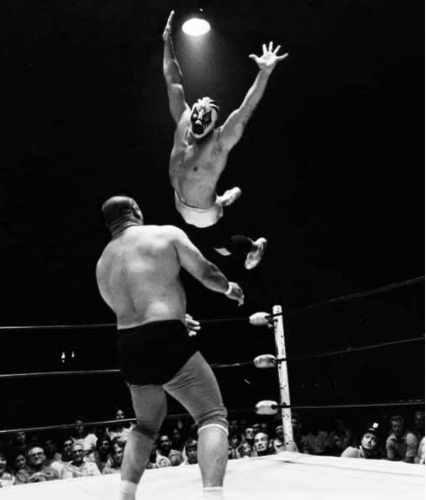
Mil Máscaras
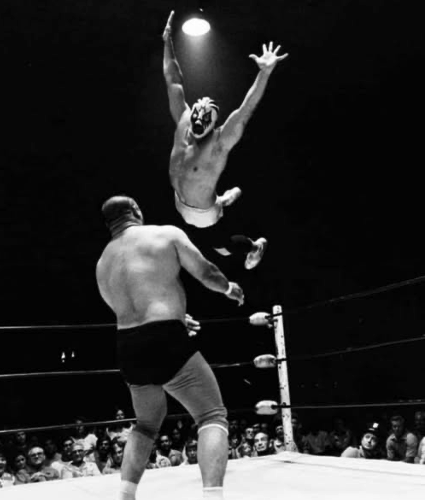
The photographs were astonishing. Máscaras threw dropkicks that seemed to begin higher than other men’s ended. He launched himself from the top rope in flying body presses, arms spread, his masked face fixed upon an opponent far below. Scott Casey had shown me on television that a wrestler could leave the earth. The magazines suggested that somewhere beyond the reach of our television signal, men had begun to live in the air.
How I wished I could have seen him move.
There was a particular ache in those photographs because they revealed and withheld at the same time. I knew that the flight had occurred. The camera had proved it. But I could not see its rhythm—the gathering of the body, the spring from the ropes, the instant of suspension, the descent, the collision. In the isolation of the pre-cable Panhandle, Mil Máscaras existed for me in arrested flight, forever above the ring and forever beyond the horizon, beyond the sunset.
After a time, the impossible became possible. Other men threw dropkicks. I saw enough of them to understand what I was seeing. The miracle did not become stale; that would be too strong and too ungrateful. It became customary. What had once enlarged the world became part of the world’s furniture.
Then, closer to the end of the Amarillo territory, “Pistol” Pez Whatley came through.
Pez did not need to invent the dropkick again. He did something nearly as difficult: he made us see it once more, and know it for the first time. He rose, extended both legs and struck his opponent—and then, at the moment of impact, pushed himself backward from the other man’s body. The push carried him into a kind of backward somersault before he landed.
That flourish accomplished nothing.
It did not injure the opponent more severely. It did not improve Pez’s position for the next hold. It may even have added an unnecessary measure of risk to his own return to the mat. Judged strictly as combat, it was superfluous.
It was also the thing that made the dropkick his.
The extra rotation belonged to the realm of style—the human compulsion not merely to do a necessary thing, but to give the doing a shape. Casey had discovered flight. Pistol Pez showed us that a man might add a flourish on the way back to earth. It was not lucha libre, and it was not quite the impossible world I had imagined from the photographs of Mil Máscaras. But it leaned in that direction. For one moment in an Amarillo ring, utility gave way to beauty.
Pistol Pez gave the dropkick back to us.
He was an artist.
***
Even now, Rey Mysterio remains one of my favorite wrestlers. I would place him on my personal wrestling Mount Rushmore without hesitation. By the standards of the dramatic storytelling I learned from Amarillo and the Southern territories, lucha libre can sometimes feel like a different theatrical form. Its grammar is not always the grammar in which I first learned to read wrestling: the patient working of a limb, the moral clarity of a broken rule, the gradual escalation toward violence, the finish prepared by everything that preceded it.
Lucha possesses other forms of logic. It is more vertical, more rhythmic, sometimes more emblematic than psychological. The mask may matter more than the face beneath it; motion may disclose character; repetition may become ritual. Its wrestlers do not merely contest the ring. They alter its geometry.
And Rey Mysterio has altered it for decades. Even now, he can make the ropes appear less like boundaries than instruments, and the air less like empty space than another surface upon which wrestling may occur. I can admire the dramatic architecture of Amarillo and still love the impossible freedom of Rey Mysterio. Love is not obliged to obey our critical categories.
But for me, all of it—the frozen photographs of Mil Máscaras, Pistol Pez Whatley’s unnecessary backward flourish, the lifelong wonder of Rey Mysterio—can be traced to one original moment. Before I could imagine lucha libre, before I knew that wrestling possessed different styles or that the ring might contain whole competing theories of drama, I saw Scott Casey rise from the dusty, grounded world of the Texas Panhandle and I’ll never forget.
A cowboy had discovered flight.
The Wright brothers came down, too. That has never been counted against them.
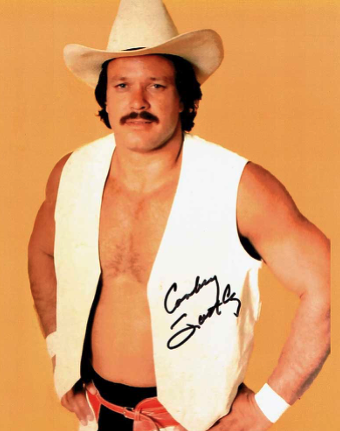
Cowboy Scott Casey