When the Champion Tapped
On the morning of Sunday, December 14, 2025, I woke up thinking about Beowulf. More particularly, I woke up thinking about the death of Beowulf.
That struck me as a curious thing. The night before, I had watched the retirement match of legendary professional wrestler John Cena. There were no Anglo-Saxon warriors in the ring, no ancient king setting out for his final battle against a dragon. There was only an aging champion, a younger opponent named Gunther, and seventy thousand people gathered in an arena expecting to celebrate one last victory.
But perhaps I should correct that. There was a dragon. His name was Gunther.
He entered to the solemn strains of Dvořák’s New World Symphony, enormous, severe, patient, almost impersonal. Gunther has never needed the flamboyance of the conventional wrestling villain. There is something elemental about him. He advances. He strikes. He endures. He does not so much seem to hate his opponents as simply to represent the force that will eventually overcome them. Against the aging Cena, especially on this night, he seemed less like another man than the embodiment of something unavoidable.
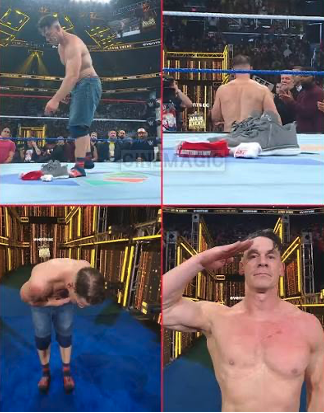
Yet the association with Beowulf did not come to me immediately. It arrived the following morning, slowly, almost as though the performance itself had continued after the arena had emptied—after John Cena had left his shoes in the ring and walked away one last time.
***
Peter Brook once suggested that the first task of dramatic criticism is not to decide whether a performance is good or bad. Before judgment comes a simpler and more demanding question: What happened? What actually took place between the performers and the audience? What changed in the room?
The longer I reflected on the previous evening’s Saturday Night’s Main Event, the more convinced I became that this was the right question. I found myself less interested in whether the booking decision was wise, or whether the ending would satisfy wrestling fans, than in something more fundamental: Had there been, for a few remarkable moments, what Brook called living theatre? Had something exceeded the machinery of performance and become a genuine human event?
Brook had remarkably little patience for arguments about artistic prestige. Indeed, one way of describing his career would be to say that he spent much of it escaping prestige in search of meaning. He was not especially interested in deciding whether opera stood above circus, whether Elizabethan drama ranked above vaudeville, or whether one artistic form possessed greater dignity than another. Those questions were largely beside the point. His question was more severe: Did life enter the performance? If it did, theatre had justified itself. If it did not, no amount of technical excellence or cultural respectability could rescue it.
That question has stayed with me as I have read Brook alongside ballet, modern dance, Shakespeare, and professional wrestling. I keep returning to wrestling because it is such a peculiar dramatic form, borrowing—without embarrassment—from classical theatre, athletics, ritual, improvisation, melodrama, soap opera, myth, and the avant-garde. Much of the result is forgettable spectacle. Occasionally, however, the familiar machinery of performance becomes unexpectedly transparent, and through it one catches sight of something much larger.
Sometimes living theatre happens.
I believe it happened on December 13, 2025.
The match between Gunther and Cena initially unfolded much as a seasoned wrestling audience might have expected. Cena answered Gunther’s assault with the sequence that had defined an entire generation: the shoulder tackles, the raised hand, “You Can’t See Me,” the Five Knuckle Shuffle. Each familiar movement produced increasing excitement because each suggested that the old story might unfold once more, one final time.
Heroes, after all, are supposed to rise again.
We have been trained by a thousand stories to expect it. The aging champion reaches somewhere deep within himself and discovers one final reserve of strength. He defeats the younger challenger, embraces the crowd, and walks away victorious. The formula persists because we want it to be true. We want to believe that courage, sufficiently summoned, can always produce one more victory.
Then Gunther secured the sleeper hold.
Every wrestling fan knows the ritual that follows, and it should be done often because it is magnificent. The referee lifts the trapped wrestler’s arm to determine whether consciousness remains. Cena’s arm fell once. Then again. An arena full of people held its breath. The referee raised it a third time—and Cena found one last reserve of strength and held it aloft himself!
The building erupted.
This was vintage Cena. This was the creed that had accompanied his career for two decades made flesh: Never Give Up.
For a moment, the old story seemed safe.
But after a devastating flurry of elbow smashes, Gunther locked the hold in again, this time in the center of the ring. There were no ropes within reach. No escape waiting at the edge of the frame. No final comeback.
Then came the moment I have found impossible to forget.
Cena looked directly into the camera.
And smiled.
Only faintly, but unmistakably.
It was not the smile of a defeated man. It was neither ironic nor bitter nor resigned. It seemed strangely peaceful, almost grateful, as though he had arrived at a place where the struggle itself was complete.
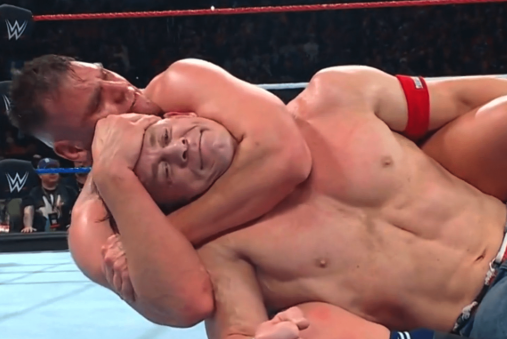
Cena Tapped
Then he tapped.
For several seconds, the atmosphere in the arena changed so completely that it was palpable even through a television screen. Seventy thousand people fell silent.
Watching from home, I remember being strangely grateful that I was not inside the building. It felt, if one may put it this way, as though the oxygen had gone out of the room. The crowd was not merely disappointed. It was bewildered. Something had happened for which the ordinary vocabulary of sports entertainment was inadequate. People raised their hands to their mouths. Others looked down or bowed their heads. Some cried.
The concept of John Cena tapping out did not exist until it happened.
What surprised me still more was my own response. I did not primarily feel sorry for Cena.
I felt sorry for the audience.
They had entered the arena expecting to celebrate a hero. Instead, they had been asked to accompany one.
That distinction, it seems to me, contains the whole dramatic event.
Brook often insisted that we should watch the audience as carefully as the performers. Attention itself is one of theatre’s principal subjects. When do spectators lean forward? When do they become distracted? When do they begin, almost imperceptibly, breathing together? And when do they cease behaving like thousands of isolated individuals and become, briefly, a community?
The silence after Cena tapped was not merely an absence of cheering. It was the presence of shared recognition. Thousands of strangers had suddenly become participants in a common human experience. They had not merely witnessed the end of a wrestling match. Together, they had encountered something that reached beyond wrestling.
Only then did I understand why I woke up thinking about Beowulf.
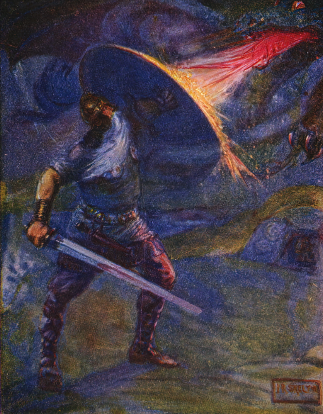
At the end of the poem, Beowulf is no longer the young warrior who tore Grendel’s arm from its socket with his bare hands and then killed Grendel’s mother. He is an old king. He has ruled for fifty years when a dragon, enraged by the theft of a cup from its hoard, begins burning his kingdom. Beowulf knows the danger. He knows, perhaps, what this final battle means. Nevertheless, he goes to meet the dragon.
And then something remarkable happens.
The great hero discovers that strength is no longer enough.
His sword fails him. The dragon closes upon him. The warriors who have accompanied their king flee into the woods—all except one, Wiglaf, who remembers what loyalty requires and goes to stand beside him. Together, the old king and the young warrior kill the dragon. But the dragon has bitten Beowulf in the neck, and its venom is already doing its work.
Beowulf wins.
And Beowulf dies.
That is the terrible beauty of the ending. The poem refuses the easier fantasy that courage abolishes mortality. The dragon can be killed, but death cannot. Beowulf’s greatness is revealed not by escaping the human condition but by meeting it faithfully. And when strength finally fails him, what remains is not another feat of strength but the presence of another person. Wiglaf stays.
The dragon in Beowulf, then, is never merely a dragon. Like the great monsters of myth, it gives visible form to something otherwise invisible: old age, mortality, the unavoidable adversary before whom every human strength must eventually reach its limit.
And on December 13, Gunther was the dragon.
Not because he was evil, and not merely because his persona carries something of the old Germanic world with it, but because that was his dramatic function. He was the force that could not finally be overcome. Cena could perform all the familiar gestures. He could summon the old strength. He could raise his arm one more time.
But the dragon had come.
Modern entertainment is very good at teaching us how heroes win. The greater stories teach us something harder: how heroes finish.
Seen in that light, Cena’s final gesture takes on an altogether different meaning. For twenty years he urged children never to surrender to fear, despair, cynicism, or intimidation. “Never Give Up” was never, or should never have been, a promise that one could outfight time itself. It was an invitation to live courageously until courage had accomplished its work.
There are, after all, different kinds of surrender. There is surrender to fear. And there is the acceptance of reality.
They are not the same thing.
Had Cena mounted one final miraculous comeback, the audience undoubtedly would have celebrated. I would have celebrated with them. But by the following morning, I doubt I would have awakened thinking about Beowulf. I certainly doubt I would still be thinking about the match eight months later. Victory would have been satisfying. What we received instead was at first more difficult yet, ultimately, more profound: not the triumph of invincibility, but the completion of a life faithfully lived.
Bertolt Brecht might say that the ending interrupted our expectations just enough to awaken reflection. We entered expecting one story and discovered ourselves inhabiting another. Instead of asking whether Cena would win, we found ourselves asking why we needed him to. Why do we insist that our heroes remain untouched by the human condition? Why should dignity require perpetual victory?
Is that not, finally, simply untrue?
Brook would press further. Alienation is not valuable because it prevents emotion. It can be valuable because it teaches us to attend more deeply. The audience that night did not become emotionally detached. Quite the opposite. They became more fully present to what they were experiencing. They ceased, for a few moments, to consume entertainment.
They participated in a ritual.
That word has become increasingly important to me.
Every culture develops rituals around the great transitions of human life: birth, marriage, coronation, death, farewell. Modern society may possess fewer shared rituals than it once did, but they continue to emerge in unexpected places. A final concert. A retirement speech. A last lecture. A farewell game. Such occasions become more than celebrations of achievement. At their best, they become communal acts of accompaniment.
Perhaps that is why another story gradually entered my thoughts.
Near the end of Big Fish, Edward Bloom’s son finally abandons his determination to separate literal fact from imaginative truth. Instead, he learns to tell his father the story his father needs in order to complete his final journey. Together they imagine the river. Together they imagine the friends waiting on the opposite shore. Then the son performs perhaps the most loving act in the story.
He gives his father permission.
“That’s how it happens,” he says. “That’s how you go.”
The words do not defeat death. They do something more human: they refuse to let a beloved man face it alone.
And this death is not defeat.
It gradually occurred to me that this was what the audience had been asked to learn that Saturday night. They entered expecting to celebrate one final victory. Instead, they were gently instructed in something rarer: how to accompany a beloved hero to the limits of mortality without demanding that he pretend to be immortal. With him, we experience the truth that we are all human.
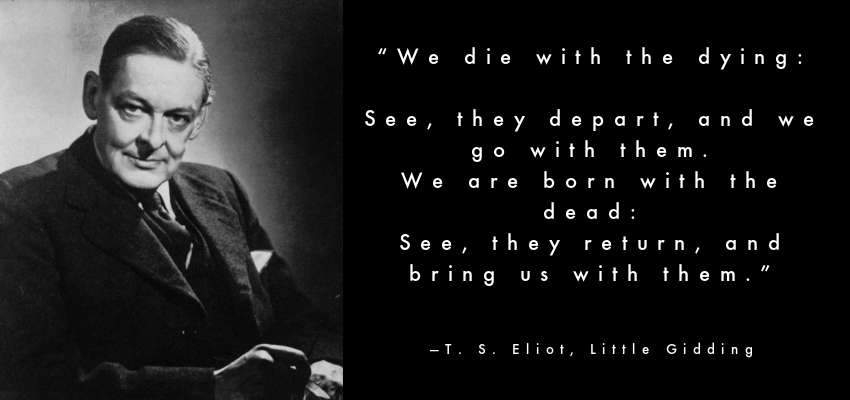
The Christian imagination quietly reveals why this pattern feels so familiar.
The New Testament never promises that faithful people will escape death; indeed, it promises precisely the opposite. Christ himself dies. Paul expects to die. Christian hope has never depended upon pretending mortality is unreal. Quite the contrary: Christianity takes death with extraordinary seriousness. Its claim is not that death can be avoided, but that death, though real, does not possess the final word.
Perhaps that is why Paul’s farewell retains such extraordinary power. He does not boast that he has won every battle. He does not pretend that death will not come. He writes instead: “I have fought the good fight, I have finished the race, I have kept the faith.”
The order matters.
Not victory, finally, but completion.
Finality.
Fidelity.
***
There is another work I keep remembering as I think about Cena’s serene smile.
Mahler’s Ninth Symphony ends not with triumph but with an Adagio that seems gradually to relinquish its hold upon the world. Leonard Bernstein, who loved Mahler almost evangelically, regarded the Ninth as a work of farewell. He heard in it not merely Mahler’s own approaching death but something larger: the passing of a musical world, even of an entire civilization. Whatever one makes of the extravagance of Bernstein’s interpretation, he understood the essential experience of the music. It does not rage forever against extinction. It becomes quieter.
And quieter.
The score itself finally asks the music to be ersterbend—dying away.
Watching Bernstein conduct those final pages is itself a lesson in accompaniment. His gestures diminish with the music. The orchestra thins. Phrases that once would have demanded continuation are permitted simply to end. There is no theatrical conquest of silence. The silence is allowed to come.
There is something almost unbearable about the last minutes of the Ninth because Mahler does not give us the ending we instinctively desire. The music does not overcome its own disappearance. It completes itself by disappearing.
And yet the strange thing is that we do not experience that disappearance as defeat. Rather, we experience it as extraordinary beauty.
Perhaps that is what great art can sometimes do. Beowulf lies dying while Wiglaf remains beside him. Edward Bloom reaches the river with his son. Mahler’s strings grow quieter until sound itself can scarcely be distinguished from silence. And John Cena, trapped in the center of the ring by the one opponent he cannot finally overcome, looks into the camera, smiles, and taps.
Different forms. Different centuries. The same ancient human problem.
How do we finish?
As I have continued to reflect on that Saturday evening, I have become increasingly convinced that Peter Brook would have had little interest in debating whether professional wrestling deserves a place among the performing arts. The question itself would have struck him as misplaced. His concern was always simpler and more demanding: Did living theatre occur? Did a performance become an event through which human beings perceived themselves and one another more truthfully than before?
I think it did.
I think it did because the performance continued after it ended. It followed me home. It sent me unexpectedly to Beowulf, and from Beowulf to Big Fish, from Big Fish to Paul, and finally to Bernstein standing almost motionless before an orchestra as Mahler’s Ninth faded into silence.
Perhaps the deepest purpose of theatre is not to teach us how heroes win. We have plenty of stories for that. Perhaps we also need art to teach communities how to accompany their heroes when winning is no longer possible.
The people who entered the arena came prepared to celebrate invincibility.
They left having rehearsed something far more valuable.
They had learned, if only for an evening, that loving a hero sometimes means allowing him to finish the race.
And perhaps that is what John Cena’s final performance was asking of all of us.
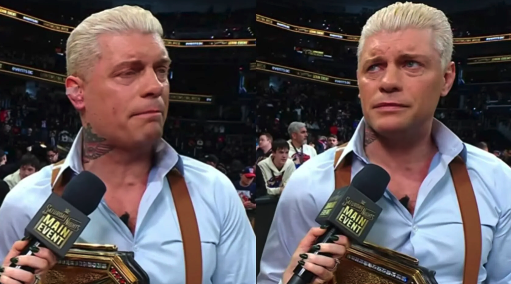
Cody Rhodes after John Cena’s final performance