Dance Essay VI — Who Tells Your Story?
Hamilton and Dance as Narrative
In previous essays on the aesthetics of dance, I have suggested that dance may become accountable to different organizing principles. In Balanchine, movement becomes accountable to musical form. In Ray Bolger, it becomes accountable to persona. In Terry Funk, it becomes accountable to conflict itself.
There is another possibility. Movement may become accountable to story. This possibility reaches extraordinary clarity in Hamilton.
Lin-Manuel Miranda's musical is rightly celebrated for its music, lyricism, historical imagination, and cultural impact. Yet one of its greatest achievements lies in something surprisingly easy to overlook. Andy Blankenbuehler's Tony Award-winning choreography is not ornamental. It is not decorative. It is not merely energetic.
It is indispensable.
Hamilton's choreography does not simply accompany the story. It becomes one of the principal means by which the story is disclosed. Narrative is revealed through movement.
Dance becomes story made visible.
Of course, Hamilton belongs to a rich tradition of dance-driven storytelling, even if Miranda and Blankenbuehler bring that tradition to an extraordinary contemporary height.
Jerome Robbins understood this brilliantly in West Side Story. Consider "Dance at the Gym."
The party scene has long provided rich dramatic material across opera, ballet, musical theater, and film. We recall Don Giovanni, Prokofiev's Romeo and Juliet, Swan Lake, The Sound of Music, even Grease with "Born to Hand Jive." Such scenes begin by establishing social order. They reveal boundaries and hierarchies, rivalries and attractions, alliances and tensions, rules and infractions. Bodies move in relation to one another, and dramatic meaning begins to emerge through spacing, rhythm, proximity, and gesture.
For the first several minutes, Robbins's "Dance at the Gym" does exactly this, and does so magnificently. It is one of the great party scenes in modern dramatic art.
Then Tony and Maria see one another.
Everything changes.
The choreography alters the entire dramatic field. The room remains full. The music continues. Bodies continue to move. Yet the meaning of every movement has changed. Before a word is spoken, the story has already taken a decisive turn.
Indeed, the entire universe we inhabit as viewers changes.
Dance is now doing more than establishing setting and context.
Dance is carrying the narrative.
That principle is essential.
Dance carries narrative when movement does more than create atmosphere or spectacle. It carries narrative when movement alters our understanding of the dramatic world itself. Movement becomes narrative when it advances the story, reframes relationships, transforms meaning, or even reshapes our experience of time.
Hamilton did not invent narrative choreography. It inherited, intensified, and transformed a tradition already well established in American musical theater.
For example, the dream ballet in Oklahoma! uses dance to externalize longing, fear, and psychological conflict. It propels forward not merely external action but interior narrative—the drama unfolding within the soul.
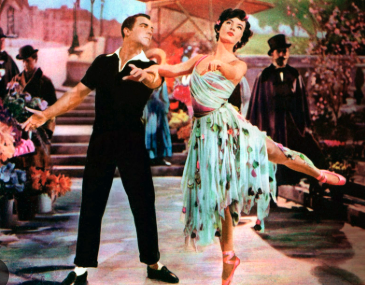
In Gene Kelly's concluding ballet from An American in Paris, dialogue ceases, yet the narrative continues. Dance becomes the primary vehicle through which emotion, memory, and dramatic resolution are disclosed. (Incidentally, Kelly was not merely the star of An American in Paris but also its principal choreographer. The concluding ballet was realized collaboratively with Vincente Minnelli's painterly visual imagination, yet the choreography itself is unmistakably Kelly's).
Hamilton inherits this tradition and develops it in a uniquely contemporary way. Indeed, it seems to take narrative choreography to another level altogether.
Its choreography functions with almost cinematic sophistication. Movement shifts perspective. Movement redirects attention. Movement accelerates or slows time. Movement changes the audience's relationship to narrative itself.
This becomes especially clear in "Satisfied." The scene is extraordinary:
We have already witnessed the event once. We believe we understand what happened.
Then time rewinds. The same moment returns. But this time, everything changes.
Bodies retrace movements. Gestures repeat. Dancers move through familiar space. Yet what seemed settled becomes newly charged with longing, regret, sacrifice, and unrealized possibility.
The choreography is not decorating the song. The choreography is doing narrative philosophy.
It makes memory visible. It makes what might have been visible.
The repeated scene seems, at first, almost to refute Eliot.
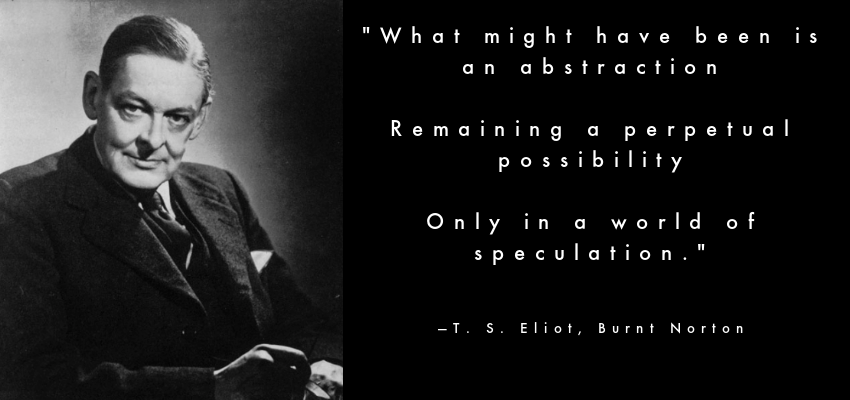
Yet Blankenbuehler performs a kind of theatrical miracle, a form of speculation, if you will.
What might have been remains unreal, but it no longer remains merely abstract. It becomes visible. An alternate possibility that never occurred now unfolds before us through movement—something embodied, moving, almost painfully real.
And in making alternate possibility visible, the choreography unexpectedly confirms Eliot's deeper insight:
Time present and time past
Are both perhaps present in time future,
And time future contained in time past.
And again:
What might have been and what has been
Point to one end, which is always present.
Dancing Time
Think about Hamilton's recurring concerns.
Immediacy.
Legacy.
History.
Mortality.
Memory.
Inheritance.
Recall "Stay Alive," "History Has Its Eyes on You," "One Last Time," "Non-Stop," "My Shot," and finally the great questions with which the musical ends:
Who lives?
Who dies?
Who tells your story?
Hamilton is, in many respects, less a musical about the American founding (though it is certainly that) than it is a musical about time itself. Its recurring concerns are not merely lyrical but choreographic as well, because they lie at the very heart of the narrative. The ensemble functions as something far greater than supporting dancers. At various moments they become history itself, memory itself, even pressure, urgency, fate, or time. They do not merely surround the principal characters; they move around them like impersonal forces larger than individual will, performing the very action of the narrative. They do not simply create the dramatic field within which the story unfolds.
They unfold it.
They are narrative forces in every respect, and their work stands among the great achievements in the history of theatrical choreography.
This, in turn, illuminates something important about the aesthetics of dance. Dance can tell stories without reducing itself to illustration. Movement need not merely symbolize narrative; it can enact it directly. Tempo can narrate. Spacing can narrate. Repetition can narrate. Reversal can narrate. Even motion and stillness can narrate. Movement – movement that matters - becomes narrative when it changes our understanding of what is happening, what has happened, and what might yet happen.
That is precisely what Hamilton achieves. It does not merely illustrate a story. It participates in telling one, revealing yet another of dance's deepest possibilities.
Dance becomes story made visible.