Essay VII — What Moves Us?
Pina Bausch and Dance as Emotional Truth
In the opening essay of this series, I proposed a deliberately simple definition: dance is movement that matters. Every essay since has explored a different answer to the question of why—and how—movement matters. In George Balanchine, movement becomes accountable to musical form. In Ray Bolger, it becomes accountable to persona. In Terry Funk, it becomes accountable to conflict itself. In Hamilton, it becomes accountable to narrative.
Pina Bausch asks us to consider something still more fundamental.
Not merely how people move.
But what moves them.
Her famous observation has become almost a manifesto:
“I’m not interested in how people move, but what moves them.”
At first glance, her Café Müller scarcely seems to confirm the thesis with which this series began. There is comparatively little dancing in the conventional sense. People walk. They stumble. They embrace. They collapse. They move chairs. They hesitate. They repeat the same actions again and again. One might reasonably wonder whether this is dance at all.
That question, however, gradually gives way to another realization.
Every movement matters.
Even movement we do not ordinarily think of as dance.
Every entrance alters the dramatic world. Every embrace changes the emotional landscape. Every chair removed, every body carried, every repeated fall, every hesitant step contributes to the unfolding dramatic truth of the work.
Perhaps, then, Café Müller does not challenge the proposition that dance is movement that matters.
It radicalizes it.
First Encounter
My first encounter with Café Müller was unlike my first encounter with Balanchine’s Agon. With Agon, confusion gradually yielded to structural clarity. What first appeared disorderly slowly revealed itself to be governed by extraordinary musical precision. Every viewing made the architecture of the work more intelligible.
Café Müller produced a different experience altogether.
It did not seem to invite solution so much as contemplation. Rather than asking me to decode a structure, it invited me to inhabit a world.
The opening establishes this almost immediately. Figures drift onto the stage as though entering from another realm. It is not entirely clear whether they are awake or asleep, living or remembered, present or absent. Ordinary categories of reality quietly begin to dissolve.
Aristotle understood that dramatic art does not simply reproduce life; it presents an intelligible world of action. Coleridge famously described the audience’s participation as a “willing suspension of disbelief.” Tolkien, perhaps more precisely, argued that great works of art create a Secondary World possessing its own internal consistency and laws, into which the audience enters not by suspending disbelief but by experiencing what he called Secondary Belief. Café Müller accomplishes precisely this. We have crossed a threshold into theatrical space where dramatic truth governs more than literal realism. The question is no longer whether the events unfolding before us could happen in ordinary life, but what kind of world we have entered and what truths govern it?
For a fleeting moment, I found myself thinking of Michael Jackson’s Thriller. Not because these figures are literally zombies—though Bausch seems almost to invite the question—but because the dancers enter the stage in much the same way that the undead enter Jackson’s famous short film. In both works, the ordinary world has already been left behind before the audience fully realizes it. We are no longer asking what is real. We are asking what kind of world we have entered.
The choice of music deepens this impression. Indeed, we need to linger here for a while.
Bausch turns to Henry Purcell, especially music from his Baroque opera Dido and Aeneas, one of the supreme tragic achievements of the Western musical tradition.
Yet, in another sense, the opera itself is almost beside the point.
Bausch is not staging Dido and Aeneas.
Nor, for that matter, is she staging Virgil's Aeneid, from which Purcell's opera ultimately draws its inspiration.
Nevertheless, the story is worth recalling, if only briefly, because it has shaped the Western imagination for more than two millennia.
Having escaped the destruction of Troy, Aeneas arrives in Carthage, where he is welcomed by its queen, Dido. The two fall deeply in love, but the relationship is doomed from the beginning. Aeneas has been entrusted by the gods with another destiny: to continue his journey to Italy and lay the foundations of what will eventually become Rome. Duty demands departure. Love demands that he remain. He leaves. Dido, abandoned and unable to reconcile love with loss, takes her own life. The tragedy is not merely that two lovers are separated, but that both are, in different ways, faithful—to love, to destiny, to obligations that cannot finally be reconciled.
It is one of the great tragic paradoxes of Western literature: neither figure is entirely wrong, yet catastrophe is unavoidable.
And yet—even this is largely irrelevant to what Bausch is doing.
She is not retelling Virgil's narrative. She is not illustrating Purcell's opera. There is no attempt to identify particular dancers as Dido or Aeneas, nor should we insist upon such correspondences.
Instead, Purcell's music establishes an emotional world into which the choreography enters.
This is music of remarkable restraint. Unlike Mahler, whose symphonic climaxes seem almost to burst the limits of expression, Purcell rarely overwhelms the listener through sheer sonic force. His grief is dignified rather than theatrical, inward rather than explosive. Long, arching vocal lines unfold over a gently pulsing ground bass. Harmonies darken almost imperceptibly. Cadences seem reluctant to arrive, as though the music itself hesitates to let go. The emotional effect is cumulative rather than immediate. We do not encounter grief as an outburst but as a condition of being.
It is precisely this emotional landscape that Bausch inhabits. The choreography does not illustrate the music. But it does dwell within the same world of longing, memory, separation, tenderness, and irrevocable loss.
One sequence in particular haunted me (approximately eleven to fifteen minutes into the performance).
A man embraces a woman. Again and again she slips from his grasp, almost as though he is incapable of holding her. Another figure, dressed in a black suit—let us call him Fate—repeatedly returns her to his arms, only for the cycle to begin again. The sequence gradually accelerates until, near its conclusion, she falls and rebounds into his embrace with increasing inevitability, eventually no longer requiring Fate's intervention. The movement has acquired its own tragic momentum.
Judged according to the standards of everyday realism, the scene is almost absurd. No one behaves this way. No one endlessly reenacts the same failed embrace.
Except, of course, people do.
Not literally. Dramatically.
Human beings return to broken relationships. We repeat destructive patterns. We attempt reconciliation that repeatedly fails. We cling to what cannot ultimately be held. We find ourselves, often against our own better judgment, living the same emotional story again and again.
That is the logic governing this scene.
Not the logic of ordinary realism, but the logic of dramatic truth.
Bausch does not ask us whether the repeated embrace could actually occur in this precise physical form. She asks whether we recognize it. And almost immediately, we do. The movement ceases to represent a single event and begins to embody a human condition. The repeated embrace is no longer merely something happening on stage; it has become an image of longing, dependency, hope, disappointment, and the mysterious persistence of love despite repeated failure.
Although we do not instinctively think of such movement as dance, it is unmistakably movement that matters. Indeed, it is difficult to imagine how these truths could be disclosed with equal force through words alone. The repeated physical action has become choreography.
The relationship shown by the movement has become the dance.
German Expressionism and Café Müller
Let us consider, too, the setting itself.
One element in particular captivated me: the brightly illuminated doorway at the rear of the stage. While much of the café remains dimly lit, this doorway seems almost to beckon from another world. It is neither entirely inside nor entirely outside. It functions less as an architectural feature than as a threshold—a passage between the strange interior world of the café and whatever mysterious reality lies beyond it. Throughout the performance, figures emerge from it, disappear through it, and seem almost to belong to it. By the end of the work, when the principal man and woman leave through that doorway still struggling, still embracing, still engaged in their endless choreography of love and loss, the drama does not conclude so much as continue beyond our sight. The stage has ended. The relationship has not.
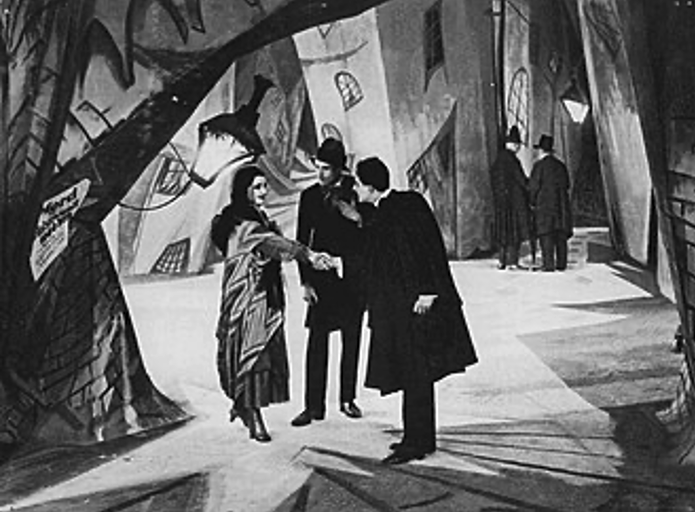
The Cabinet of Dr. Caligari, 1920.
Here, Bausch reminded me unexpectedly of German Expressionism. Films such as The Cabinet of Dr. Caligari or Nosferatu are not compelling because they imitate ordinary life. Their distorted architecture, impossible perspectives, stylized movement, and exaggerated gesture reveal interior realities that realism often conceals.
The sets in Caligari are famously unrealistic. Streets bend impossibly. Windows lean. Shadows are painted onto walls rather than cast by light. Buildings seem almost to participate in the psychology of the characters themselves. The physical world has ceased to function as objective scenery. It has become an expression of consciousness.
Something remarkably similar occurs in Café Müller. Bausch's stage is not simply a café. It is the visible architecture of memory, longing, vulnerability, and emotional exhaustion. The chairs are not merely furniture. The doorway is not merely an exit. The darkness is not merely lighting design. Every element participates in the dramatic action. The physical environment becomes an extension of the interior lives of the people who inhabit it.
This is one of the defining achievements of Expressionism. External form no longer imitates external reality; it reveals interior reality. Physical distortion discloses emotional truth. The stage becomes less a room than the landscape of the human heart.
***
This realization brought me back—perhaps unexpectedly, perhaps inevitably—to professional wrestling.
At first glance, the comparison seems almost absurd. Yet the dramatic logic is remarkably similar.
Professional wrestling has never depended upon literal realism. No one mistakes an Undertaker resurrection, a Hulk Hogan comeback, or Terry Funk's impossible returns for documentary fact. The audience is not asking, "Did this really happen?" It is asking something much deeper:
“Do I recognize this?”
Do I recognize perseverance?
Do I recognize betrayal?
Do I recognize redemption?
Do I recognize grief?
Do I recognize hope refusing to die?
The physical action is stylized precisely so that these realities may become unmistakably visible.
Bausch employs the same dramatic principle. The repeated falls, embraces, and impossibly persistent gestures are not realistic because realism is not their aim. They are true because they render visible emotional realities that ordinary behavior seldom reveals. The physical action is intensified, repeated, and distilled until the audience no longer sees merely bodies moving through space but the emotional life those bodies disclose.
This, I think, is one of the deepest purposes of dramatic art. Drama does not abandon reality; it penetrates beneath its surface. By relinquishing mere documentary accuracy, it often becomes capable of expressing truths that documentary realism alone cannot adequately reveal.
Perhaps that is why Aristotle remains so relevant. In the Poetics, he famously argues that poetry is “more philosophical” than history because it presents not merely what has happened, but what could happen according to probability or necessity. History records particular events. Drama discloses universal patterns of human action. Its first responsibility is therefore not factual precision but Truth.
Bausch understands this instinctively.
***
Another discovery surprised me.
Throughout Café Müller, chairs continually enter the dramatic action. They are moved, removed, collided with, carried away, and repeatedly become obstacles to human encounter. They are not scenery. They are participants.
Watching this, I found myself thinking first of Fred Astaire, who possessed the astonishing ability to transform almost any ordinary object into a dancing partner. A hat rack became elegant company. An old-school gymnasium became an orchestra of ladders, parallel bars, pommel horses, cable extension and juggling clubs, each object drawn effortlessly into his dance.
Everything about Astaire's interaction with these objects is imaginative, technically flawless, playful, and deeply satisfying. The objects themselves seem almost to delight in participating. They become extensions of grace.
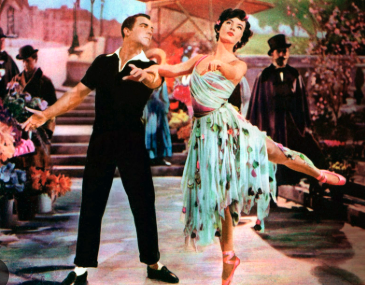
Nor need we linger long over Gene Kelly's umbrella in Singin' in the Rain, which has become one of cinema's enduring symbols of exuberant joy. Kelly does not merely carry the umbrella; he persuades us that it wishes to dance with him.
Bausch asks something entirely different.
Her chairs do not become partners.
They become resistance.
They obstruct movement. They separate lovers. They clutter the landscape through which human beings attempt, and often fail, to reach one another. The physical world itself seems to have become burdened with accumulated memory and emotional weight. The furniture no longer assists the dance; it complicates it.
Unexpectedly, this brought me once again to Terry Funk and Mick Foley. Here, too, ordinary furniture enters the dramatic action, but in an altogether different register. Metal folding chairs cease to be furniture and become the landscape of conflict itself.
What makes the famous ECW incident linked below especially remarkable is that this transformation was not scripted. The audience became an active participant in the drama, showering the ring with hundreds of folding chairs. In doing so, they inadvertently co-authored one of professional wrestling's most unforgettable theatrical moments—at considerable physical risk to both Funk and Foley. (One suspects, however, that neither man would have wanted it any other way.)
What, then, has happened?
The object has not changed.
The chair remains a chair.
What changes is the dramatic world into which the chair has been received.
In Astaire's world, the chair—or the hat rack, or the gymnasium apparatus—becomes an invitation to elegance and play. In Kelly's, an umbrella becomes exuberance made visible. In Bausch's, the chair becomes emotional resistance. In Terry Funk's world, the folding chair becomes conflict-embodied and weaponized.
The object itself remains constant.
Its dramatic ontology does not.
This, too, is movement that matters.
***
Watching Café Müller, I became increasingly convinced that no two viewers will experience precisely the same work.
One viewer hears Purcell.
Another sees German Expressionism.
Someone else encounters memory, childhood, abandonment, reconciliation, or grief.
I found myself thinking of Virgil, Terry Funk, Thriller, Dido, Expressionist cinema, Tolkien's Secondary World, even Aristotle's account of dramatic truth.
Are these responses merely subjective?
I do not think so.
Nor do I believe they are arbitrary.
Great works possess a remarkable integrity that both invites and disciplines interpretation. They do not mean whatever we wish them to mean. Yet neither do they exhaust themselves in a single “correct” reading. Rather, they invite us into a sustained conversation, one in which the work continually discloses new aspects of itself while gently resisting interpretations that cannot be sustained by what actually appears before us.
Sondra Fraleigh helps us understand why this is so. In Dance and the Lived Body, she writes:
The aesthetic exists intrinsically within the subjective field. It becomes a value when it is termed aesthetic value, a quality of subjectivity toward which we take a positive attitude. Such subjective qualities are nothing more than the qualities of our own experience—lived qualities, which are finally affirmed as lived values, or the good in experience. This tells us that aesthetic values are founded in subjectivity, that they have their source in felt life...
Fraleigh is not arguing for relativism. But she is reminding us that aesthetic experience always occurs within a lived human consciousness. We do not encounter works of art as detached recording devices but as persons—with histories, memories, hopes, disappointments, and loves. The work remains the same, yet what it awakens within each attentive viewer may differ profoundly.
Pina Bausch understood this as well. She once observed:
"The things we discover for ourselves are the most important."
That sentence, I think, reveals something essential about Café Müller. The work does not hand us conclusions. It creates the conditions under which discovery becomes possible. Its meanings are not hidden like answers waiting to be decoded; they emerge through attentive participation. We leave the theater not when every mystery has been solved, but when we ourselves have somehow been drawn more deeply into the mystery.
Perhaps this is what makes Bausch so inexhaustible.
I do not mean inexhaustible in the nihilistic sense that "anything goes," as though the work means whatever anyone wishes it to mean. Such a view ultimately empties art of significance altogether. If every interpretation is equally valid, then no interpretation is particularly meaningful.
Bausch asks something much more demanding of us.
She invites us to bring ourselves.
Our histories.
Our disappointments.
Our hopes.
Our memories.
Our reading.
Our loves.
Our wounds.
Yet she also asks us to attend faithfully to the work itself. It is the encounter between these two realities—the integrity of the work and the lived experience of the viewer—that gives rise to aesthetic discovery.
Because we are not isolated consciousnesses but members of a shared human tradition, our discoveries will often overlap. We inherit many of the same stories, the same tragedies, the same music, the same philosophical questions. Virgil, Shakespeare, Purcell, Eliot, the Gospels, German Expressionism, professional wrestling, and countless other dramatic traditions become part of the imaginative world we carry with us into the theater. Great works awaken these memories, not because they quote them directly, but because they inhabit the same landscape of human experience.
Perhaps that is why Bausch continues to reveal new things with each viewing.
Or perhaps that has simply been my own experience.
***
There is, of course, much more that could be said about Café Müller. One could write an essay on the haunting female soloist who seems almost to inhabit another drama entirely. She rarely enters the central relationship that dominates the work, yet her presence is unforgettable. She appears less as a participant in the principal action than as another consciousness moving through the same emotional landscape, quietly reminding us that every human life contains stories that intersect only partially with those of others.
Or one might linger over the remarkable red-haired woman who appears first in heels, then barefoot, then again in heels. She seems governed by a different gravity from everyone else on the stage. Playful, elusive, faintly mischievous, she moves through the work almost like a theatrical spirit—never quite malevolent, never entirely benevolent, but always unsettling. My own imagination kept returning, oddly enough, to Tinker Bell: a figure who seems to belong to the world without ever being fully contained by it.
Perhaps that is part of Bausch's achievement. Every attentive viewer will notice different things, and the work is generous enough to reward each genuine discovery.
Stepping back from Café Müller, one begins to see more clearly how Bausch both belongs to, and enlarges, the tradition explored throughout these essays.
Like Balanchine, she demands careful attention. Neither choreographer reveals the full richness of the work at first encounter. Yet they reward different kinds of attention. Balanchine gradually reveals order. The more carefully one watches and listens, the more clearly the architecture of the dance emerges until movement and music become inseparable. Bausch reveals something different. She does not gradually disclose structure so much as depth. Each return uncovers not another solution but another layer of human experience.
Nor does Bausch offer the immediate delight of watching performers such as Fred Astaire, Gene Kelly, Ray Bolger, John Travolta, or even Michael Jackson. Their genius announces itself almost instantly. We marvel at Astaire's effortless elegance, Kelly's athletic exuberance, Bolger's elastic individuality, Travolta's irresistible charisma, Jackson's astonishing rhythmic invention. Their dances delight before they provoke reflection, although they richly reward both.
Bausch reverses that order.
She unsettles before she delights.
She invites contemplation before admiration.
Her choreography is not immediately beautiful in the conventional sense, yet it gradually reveals another kind of beauty—one rooted not in technical display but in emotional truth. We leave Café Müller less certain that we have understood it than aware that it has somehow understood us.
This, I believe, is one of Bausch's greatest gifts—not only to the aesthetics of dance but to aesthetics itself.
Dance need not consist solely, or even primarily, of codified steps, virtuosic technique, or conventionally beautiful movement. It consists of movement that matters. Sometimes that movement becomes accountable to music. Sometimes to persona. Sometimes to conflict. Sometimes to narrative.
And sometimes it becomes accountable to the human condition itself.
Bausch once said that she was not interested in how people move, but in what moves them. After watching Café Müller, I have come to think that her insight and the thesis with which this series began are not competing ideas but complementary ones.
What moves us becomes movement that matters.
And when it does, we call it dance.