Essay V — For Forty Years We Danced Terry Funk and Dance as Agon
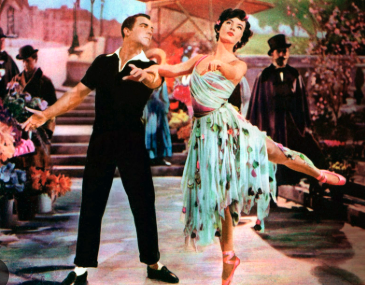
In the previous essays, I have suggested that dance may become accountable to different organizing principles. In Balanchine, movement becomes accountable to musical form. In Ray Bolger, movement becomes accountable to persona. The body itself acquires a distinctive theatrical identity.
There are other possibilities.
Movement may become accountable to conflict.
This possibility appears in an unexpected place.
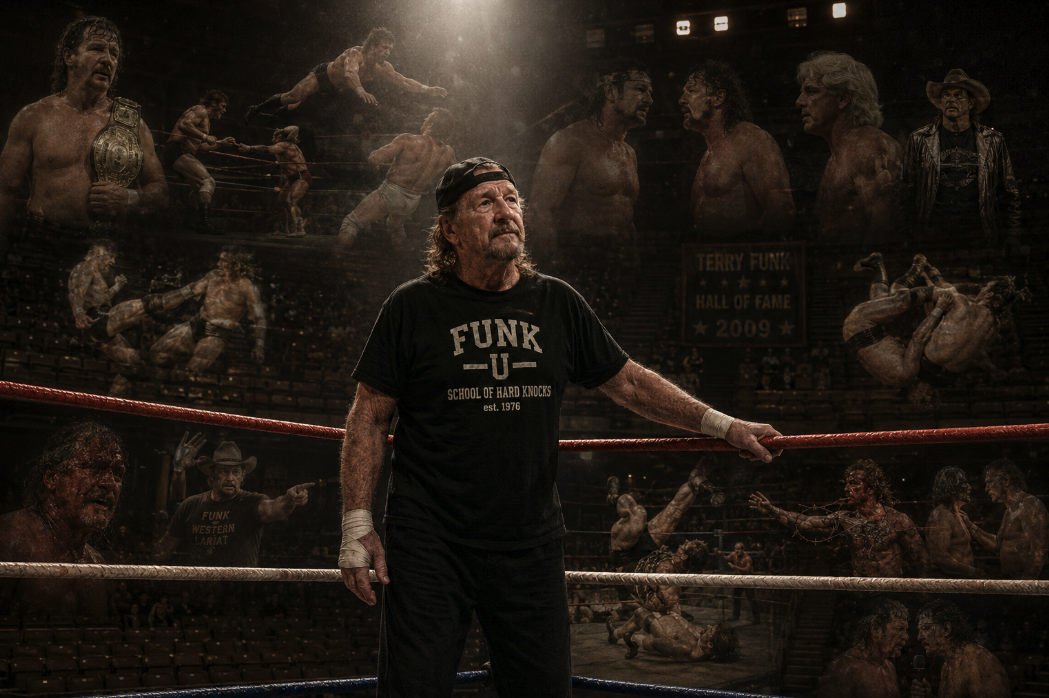
In his WWE Hall of Fame acceptance speech, professional wrestler Terry Funk reflected on a lifetime in the industry:
"We danced to capacity crowds. We danced to sparsely filled arenas. We danced our best. Night after night, week after week, month after month, year after year. For forty years we danced. Now, the music's died. The bell rings no more."
This statement is obviously not literally true.
Terry Funk was not a ballet dancer. He was not a member of a dance company. For forty years, he wrestled, which is to say, he performed narrative-driven, physically demanding, often dangerous dramatic conflict in collaboration with other performers.
And yet I would wager that no one familiar with his work who hears Funk say, “We danced!” experiences his words as false.
On the contrary, they strike the listener as deeply insightful and truthful, even poetic.
Why?
Part of the answer is that Funk is naming something larger than athletic competition and something deeper than theatrical performance. He is attempting to describe a form of movement that unfolds between opposing bodies over time. Not merely a sequence of moves, but a relationship. Not merely a contest, but a pattern of reciprocal action and reaction.
A dance is not defined by music alone. It is defined by movement that matters , movement organized around an intelligible principle. If Balanchine teaches us that dance may become accountable to form, and Bolger teaches us that dance may become accountable to persona, Terry Funk teaches us that dance may become accountable to conflict itself.
To understand why that matters, it is helpful to begin somewhere unexpected: not in a wrestling ring, but on the streets of New York in West Side Story.
Consider the famous opening sequence:
What is remarkable is not merely the famous rumble. The choreography—indeed, the dance—begins long before the fighting starts. Young men walk through the city. They point. They gather. They throw a basketball. They stare. They occupy territory. They challenge one another with posture, proximity, and movement.
Much of this is not dance in the conventional sense at all. It is ordinary movement: walking, turning, looking, gathering.
Yet Jerome Robbins and the dancers somehow make every gesture matter. A step, a glance, a finger snap, a turn of the head—each alters the dramatic situation. Every movement advances, clarifies, or intensifies the conflict. We know where the story is headed long before the rumble begins because the choreography has already made the antagonism visible.
The movement remains recognizably urban, vernacular, and human, yet it has become charged with dramatic significance.
Conflict has already become choreography.
Only later does the famous rumble begin—beginning, remarkably enough, with what a wrestling audience would immediately recognize as a flying body press before dissolving into something astonishingly close to a battle royal. Bodies collide, separate, regroup, and collide again. But the fight itself is the culmination of a process that began much earlier.
The agon began before the first blow.
This observation allows us to understand what Terry Funk was trying to say.
In Robbins, conflict becomes dance.
Incidentally, I think we now know why Lin-Manuel Miranda, who provided Spanish-language translations for the 2009 Broadway revival of West Side Story, loves professional wrestling. I would wager he has watched the opening sequence a hundred times or more.
Lin-Manuel Miranda’s Opening to WrestleMania 42
In professional wrestling, the relationship becomes even more intimate.
The wrestlers are not “dancing about conflict”. The conflict itself becomes the dance.
This distinction is crucial.
Every movement exists because another body exists. Protagonist and Antagonist compete for the same space. Every adjustment answers another adjustment. Every advance produces retreat. Every retreat invites pursuit. Every feint generates response. Every gesture alters the field of possibilities available to the other participant. The movement is reciprocal from beginning to end.
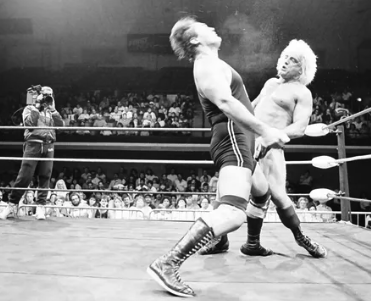
A single dropkick is not a dance. A single headlock is not a dance. A single Ric Flair flop is not a dance.
But the unfolding pattern of reciprocal adjustment between opposing bodies occupying the same contested space becomes something else entirely. The meaning does not reside in any individual movement. It emerges from the relationship between movements.
Conflict acquires form.
Movement becomes accountable to opposition.
Or perhaps more precisely:
Dance becomes concentrated agon.
The Greek term agon originally referred to contests of many kinds—athletic, legal, poetic, and dramatic. Aristotle largely assumes the concept rather than formally defining it, but his account of drama as the imitation of action places conflict and opposition near the center of theatrical experience. Later thinkers, especially Nietzsche in Homer's Contest, would make the agonistic character of Greek culture even more explicit. The ancient Greeks understood that conflict, when given form, could become not merely destructive but intelligible, meaningful, and even beautiful. Balanchine and Stravinsky drew upon this tradition when they named their ballet Agon. Professional wrestling employs the same principle in a different register.
This helps explain why wrestling occupies such an unusual position among the dramatic performing arts.
A boxing match may be beautiful. A martial arts form may be beautiful. Gymnastics may be beautiful. Yet these activities remain accountable above all to practical objectives. Their movements instantiate solutions to competitive athletic problems.
Professional wrestling operates differently.
The audience is not merely watching bodies compete. It is watching performers cooperate in the creation of visible conflict.
It is watching antagonism become visible through movement. It is embodied conflict presented aesthetically and dramatically.
Yet even this remains incomplete.
For Terry Funk's statement is not ultimately about individual matches. Like all good poetry, he is describing something immediate and something much larger.
When he says, "For forty years we danced," he is not simply describing a sequence of holds and maneuvers.
He is describing an entire life.
His entire life.
His entire life within the community, history, and tradition of his chosen dramatic art:
Territories.
Promos.
Road trips.
Partners.
Opponents.
Victories.
Defeats.
Packed arenas.
Empty arenas.
Pain.
Injury.
Death.
The dance extends through time.
A single match may be a dance. A rivalry may be a dance. A career may be a dance. Perhaps even an entire mythology may be a dance.
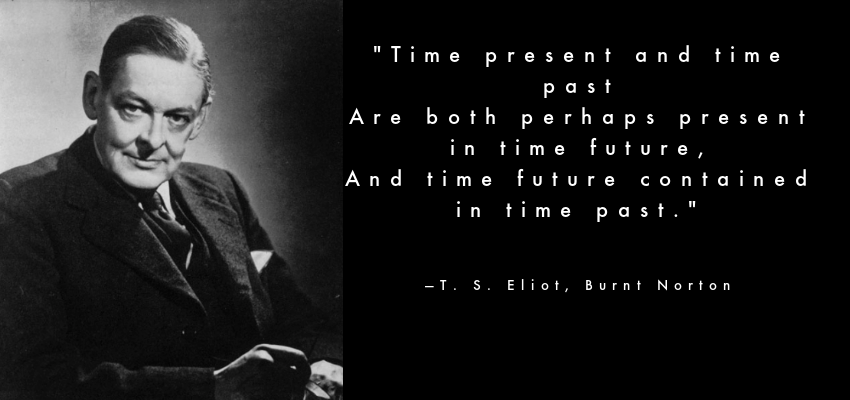
At this point, Terry Funk's words begin to sound unexpectedly close to T. S. Eliot.
Past and future gather within the present moment.
The Antagonist standing across the ring carries decades of accumulated memory. The movement taking place now contains movements that occurred years earlier. The dance acquires historical depth.
The dance becomes memory.
The dance becomes myth.
This helps explain why certain moments in the dance that is professional wrestling generate emotions that seem wildly disproportionate to the immediate action taking place. The audience is responding not merely to what is happening, but to everything that has happened before. Years of rivalry, memory, expectation, triumph, failure, loyalty, betrayal, and hope suddenly gather themselves into a single moment.
A figure such as The Undertaker appears, and an entire mythology enters the arena.
Rey Mysterio's mask is threatened, and generations of lucha tradition stand at risk.
Cody Rhodes finally finishes his story, and the reaction spreads far beyond the ring itself. Samantha Irvin struggles to contain her emotion while making the announcement. Charles Robinson presents the championship belt as though participating in a coronation that happens only once every century. Michael Cole's count of "one, two, three" ceases to be commentary and becomes witness.
In such moments, the movement itself is not doing all the work.
The history is moving.
The mythology is moving.
The dance has expanded beyond the ring.
Terry Funk understood this intuitively. More than that, he understood it poetically.
There is something Homeric about his Hall of Fame speech. Funk was not merely a participant in the dance. He became one of its interpreters. The warrior became the storyteller. Achilles became Homer.
That is why he did not say:
"We fought."
Nor did he say:
"We performed."
Nor even:
"We entertained."
He said:
"We danced."
And in doing so he identified something profound about conflict, memory, performance, and embodied storytelling. He also identified something profound about the aesthetics of dance.
For there are occasions when movement becomes accountable to opposition itself. When struggle acquires form and conflict becomes visible. When antagonists organize an entire world of meaning through reciprocal movement.
At such moments, agon becomes dance.
And when the music finally dies and the bell rings no more, what remains is not merely the memory of competition. It is the memory of a life spent moving in relation to others—opponents, partners, rivals, friends, enemies, and audiences. A life organized by struggle, shaped by performance, and sustained by meaning.
It is the memory of a life spent dancing.