Balanchine, Agon, and the Visibility of Music - Essay III
In the first essay of this series on the aesthetics of dance, I suggested that dance begins where movement makes a difference—where motion becomes meaningful within a shared field of attention. In the second, drawing on T. S. Eliot, I argued that such movement becomes intelligible only when it is held together by a center, a “still point” around which the dance unfolds.
We are now in a position to take a further step.
If dance is movement that matters, and if movement matters because it is organized around a center, then we may ask:
What, in a given work, is the movement accountable to?
In the case of George Balanchine—and especially in his collaboration with Igor Stravinsky in Agon—the answer is clear:
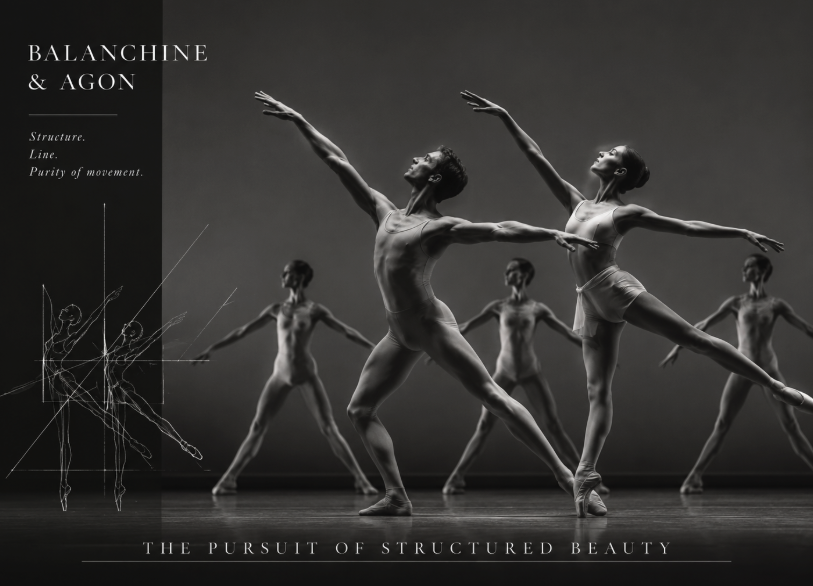
The movement is accountable to form. More precisely, to musical form. In Balanchine, dance becomes form made visible.
First Encounter
My own first viewing of Agon was not, at first, one of immediate clarity.
Very quickly, a question arose: why are the dancers not moving together?
The eye searches instinctively for unison. One expects the bodies on stage to align rhythmically, to strike the same accents, to move as a single coordinated unit. Instead, something else appears. One dancer holds a line while another cuts across it. A third seems to enter at a different moment altogether. The stage feels, at first, almost disjointed.
One is tempted to think that something is wrong.
But with attention, that impression begins to shift. What first appears disordered reveals itself as a more intricate kind of order. The dancers are not failing to move together; they are following different lines within the same structure. What seemed unintelligible becomes, slowly, precise.
Layered.
Mesmerizing, in fact, precisely because it does not yield itself immediately.
The order is there from the beginning, but it is not at first apparent. It must be seen. Listen and watch closely enough and the structure gradually reveals itself.
Seeing the Music
This is where Balanchine’s great achievement becomes evident.
Those who find Stravinsky difficult—as I often have—might do well to begin not with musicological analysis but with Balanchine. It is simply easier, at least for many listeners, to grasp immediately what is happening in Mozart, Schubert, or Mahler than in Stravinsky. The Rite of Spring is perhaps an exception; its force is unmistakable. But much of Stravinsky’s music can initially feel angular, elusive, even opaque.
Balanchine changes this, if you let him.
His choreography renders audible structure visible. The choreography is, in a real sense, embodied Stravinsky. What first appears disjointed resolves into coherence once one recognizes that the dancers are not failing to keep time; they are keeping time with different strands of the same musical architecture.
A sharp accent in the score becomes a sudden turn or shift in direction. A sustained phrase becomes an extended line held in space. Contrasting rhythms appear as contrasting movements—one dancer quick and angular, another elongated and suspended.
The choreography does not illustrate the music.
It does not decorate it.
It reveals it.
One begins to see the music as one might see the structure of a building or the geometry of a painting. Relationships become perceptible: symmetry and asymmetry, tension and release, opposition and balance. The ear may not yet fully grasp the logic of the score, but the eye begins to understand it.
And once it is seen, it can be heard.
I suspect I am not the only person who learned how to listen to Stravinsky aided by Balanchine.
Indeed, Balanchine may even illuminate something that critics such as Theodor Adorno missed in Stravinsky. Adorno heard in Stravinsky a kind of cold formalism—mechanism, ritual, depersonalized structure. But Balanchine reveals something else: not dead mechanism, but living form embodied in human movement. The choreography humanizes the structure without weakening it.
The Still Point of Form
At this point, Eliot’s insight returns with renewed clarity.
If every dance requires a center—a still point that holds the movement together—then in Balanchine that center is no longer hidden. It is made perceptible in the structure of the work itself.
Balanchine’s dancers do not move toward narrative resolution. They do not embody characters, nor do they express psychological states. Instead, their movements are governed by the demands of form, and in particular, musical form.
Each gesture answers to rhythm, phrasing, spatial relation, and musical architecture.
The dance holds together because the form holds.
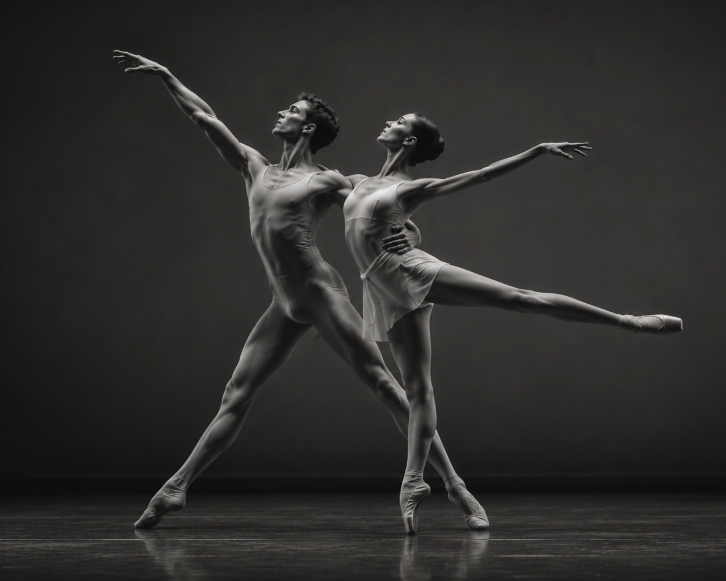
The pas de deux
Each gesture answers to rhythm, phrasing, spatial relation, and musical architecture.
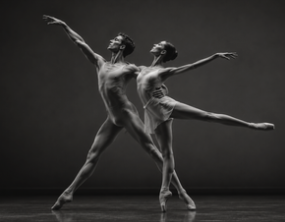
This becomes especially apparent in Agon in the celebrated pas de deux. Dancers who have performed it often speak of the choreography in relational terms—as contest, negotiation, even struggle between the two bodies. This is not wrong. The ballet is titled Agon, after all. But such interpretations arise from the form; they do not precede it.
The dance is not “about” a relationship in the dramatic sense. Rather, the relationship is what the form feels like from within.
One ballerina who performed the work remarked on the extraordinary difficulty of remaining en pointe throughout the duet while negotiating constantly shifting balances and spatial relationships with her partner. Once seen, this cannot be unseen. What appears effortless is in fact exactitude. The slightest error of spacing or timing would cause the form to collapse.
What the audience perceives as tension, competition, or even dominance is, more fundamentally, the visible trace of bodies submitting themselves to the same demanding geometry.
This is why Agon can withstand even the unexpected. In one filmed performance, a dancer’s shoe flies off during a forceful movement. The accident is real, and yet the dance does not collapse. The structure remains intact. The movement continues to make sense because it is accountable not to surface perfection, but to an underlying order.
The still point is not the individual body, nor any single moment.
It is the form itself.
A Note on Presence
There is, however, a moment in that same performance that invites a different kind of reflection.
Arthur Mitchell appears in the Agon (linked here & above) in the famous pas de deux with a white ballerina—an image that, in 1960, was not without controversy, even in New York City. It would be easy, from a contemporary standpoint, to interpret Balanchine’s use of Mitchell primarily as social commentary or deliberate provocation.
But to lead with that reading would be to misunderstand Balanchine.
Balanchine did not make statements. He made ballets.
Mitchell is present because he is superb—because the demands of the choreography require a dancer of his clarity, strength, and musical intelligence. He is not merely excellent; he is indispensable. The integrity of Agon, performed by the New York City Ballet under Balanchine himself, admits no compromise. (Stravinsky was often present at rehearsals.) The form must be realized fully, and the dancer capable of realizing it must therefore be used.
That is not propaganda or political messaging of any sort.
It is artistic necessity.
And it is admirable precisely because it refuses to subordinate the work to anything outside itself.
Form Made Visible
What, then, does Agon teach us about the aesthetics of dance?
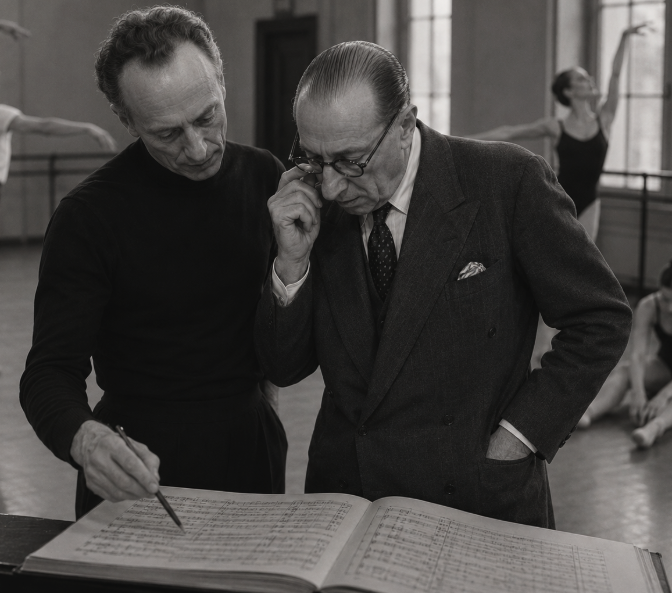
It shows us that dance need not depend upon narrative, character, or overt emotional expression to be fully intelligible and deeply compelling.
Movement can matter because it reveals structure.
Dance, in its purest form, is form made visible. In Balanchine, that form is musical.
This does not make the dance abstract in the sense of being empty or detached. On the contrary, it makes the dance precise. Every movement is necessary because it answers to something beyond itself. Nothing is arbitrary.
And from this precision emerges beauty.
Not decorative beauty, nor sentimental beauty, but the beauty of form fully realized—the beauty that appears when movement, music, balance, spacing, and rhythm align with exactness and clarity. One senses here, however faintly, the persistence of a profoundly classical intuition stretching back at least to Plato: that beauty is not opposed to order, but revealed through it.
Return to the Series
In the essays that follow, we will encounter other ways in which movement becomes intelligible—movement accountable to the lived body, to narrative, to persona, to conflict.
But Balanchine gives us something foundational.
He shows that movement that matters can be held together not by story, not by character, not even by shared rhythm, but by form alone.
And in doing so, he brings us back once more to Eliot.
Without the still point, there would be no dance.
In Agon, the still point is no longer hidden. It is made visible. And what we perceive, finally, is the dance.