Essay II — The Still Point
T. S. Eliot and the Condition of Dance
In the opening essay of this series, I suggested that dance begins where movement makes a difference—where the motion of bodies alters a situation in a way that becomes meaningful, perceptible, shareable, and repeatable within a field of attention. Movement, at that point, ceases to be mere displacement and becomes something that can be attended to again. It acquires form, and in form, meaning.
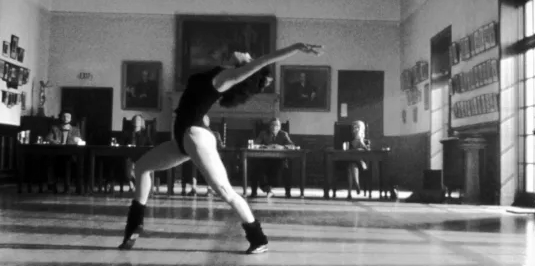
Before turning to particular choreographic traditions in order to build out an aesthetics of dance, however, it is worth pausing over a remarkable image from Burnt Norton, the first of Four Quartets by T. S. Eliot.
Eliot is not writing directly about choreography, nor even about the performing arts. His subject is far larger. Throughout the poem he is attempting to think about time—about memory, possibility, eternity, and the strange way in which the past and future seem to gather within the present moment.
Yet when Eliot searches for an image capable of expressing this structure, he turns instinctively—and correctly—to dance.
At the still point of the turning world. Neither flesh nor fleshless;
Neither from nor towards; at the still point, there the dance is,
But neither arrest nor movement. And do not call it fixity,
Where past and future are gathered. Neither movement from nor towards,
Neither ascent nor decline. Except for the point, the still point,
There would be no dance, and there is only the dance.
This is rightfully one of the more famous passages in all of Four Quartets. Eliot speaks of a “still point of the turning world,” and says that it is there that the dance occurs. The paradox is immediately evident. The dance appears to depend upon a point that is neither motion nor immobility, neither coming nor going, neither ascent nor decline. Without this still point, Eliot suggests, there would be no dance at all—and yet what we perceive is not the still point itself, but only the dance.
The lines possess an uncanny quality. Anyone who has watched great dancing recognizes that Eliot has somehow said something perfectly true and profound. And yet when asked to explain the passage, one is often tempted simply to repeat it. The insight seems to resist paraphrase.
Nevertheless, Eliot’s intuition is not as mysterious as it first appears. Though he is not writing about the aesthetics of dance, he does illuminate dance because he points toward a condition of motion itself.
Movement becomes intelligible only when it is organized around a center. Motion is discernible only in relation to something that does not move. A wheel turns around its hub. A planet orbits around a gravitational focus. A spinning object remains coherent only so long as its axis holds. Remove the center and movement ceases to be movement in any recognizable sense; it becomes mere disorder. One might recall Aristotle’s reflections on motion in the Physics, where movement is always understood in relation to a principle that gives it form and intelligibility. Or, in a darker register, one might recall W. B. Yeats’s image of anarchy in The Second Coming: “things fall apart; the centre cannot hold.”
Dance reveals this truth with particular clarity because the dancer’s body literally possesses such a center. An experienced dancer will tell you that balance, rotation, and extension all depend upon what ballet training simply calls the center. Turns originate there. Jumps stabilize there. Lines extend outward from it. Without that internal orientation, motion collapses into flailing.
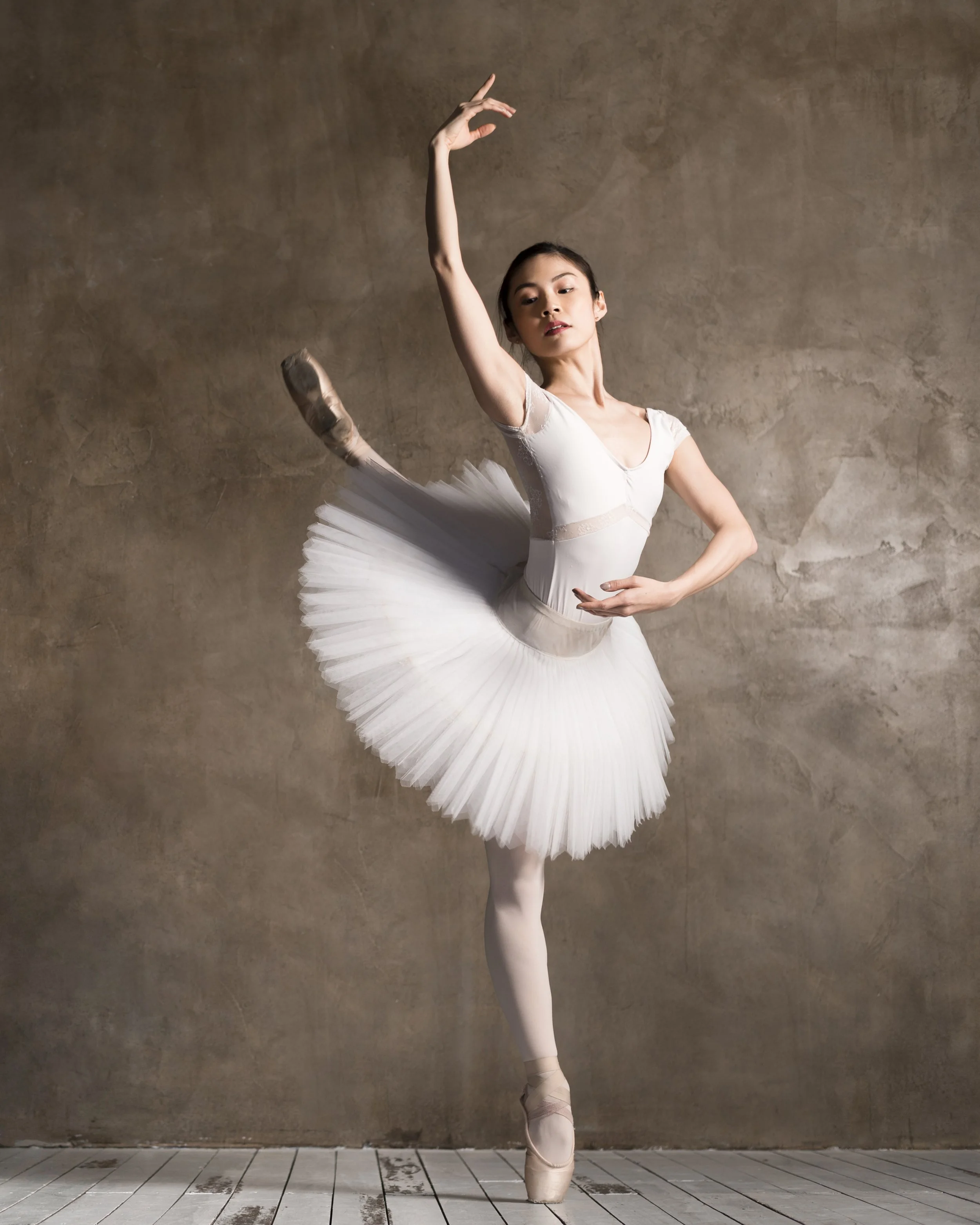
Nowhere is this clearer than in the classical technique of dancing en pointe. To the casual observer the dancer appears to balance precariously on the very tips of the toes, as though the feet themselves were the still point of equilibrium. But every trained dancer knows that the opposite is true. The stability required for pointe work originates not in the feet but in the center of the body. The narrow point of contact merely transmits the balance already established there. Remove that inner orientation and the dancer cannot rise onto pointe at all.
The dancer may appear to be moving freely through space, but every movement is secretly organized around a stillness within the body.
Eliot’s image captures precisely this beautiful paradox.
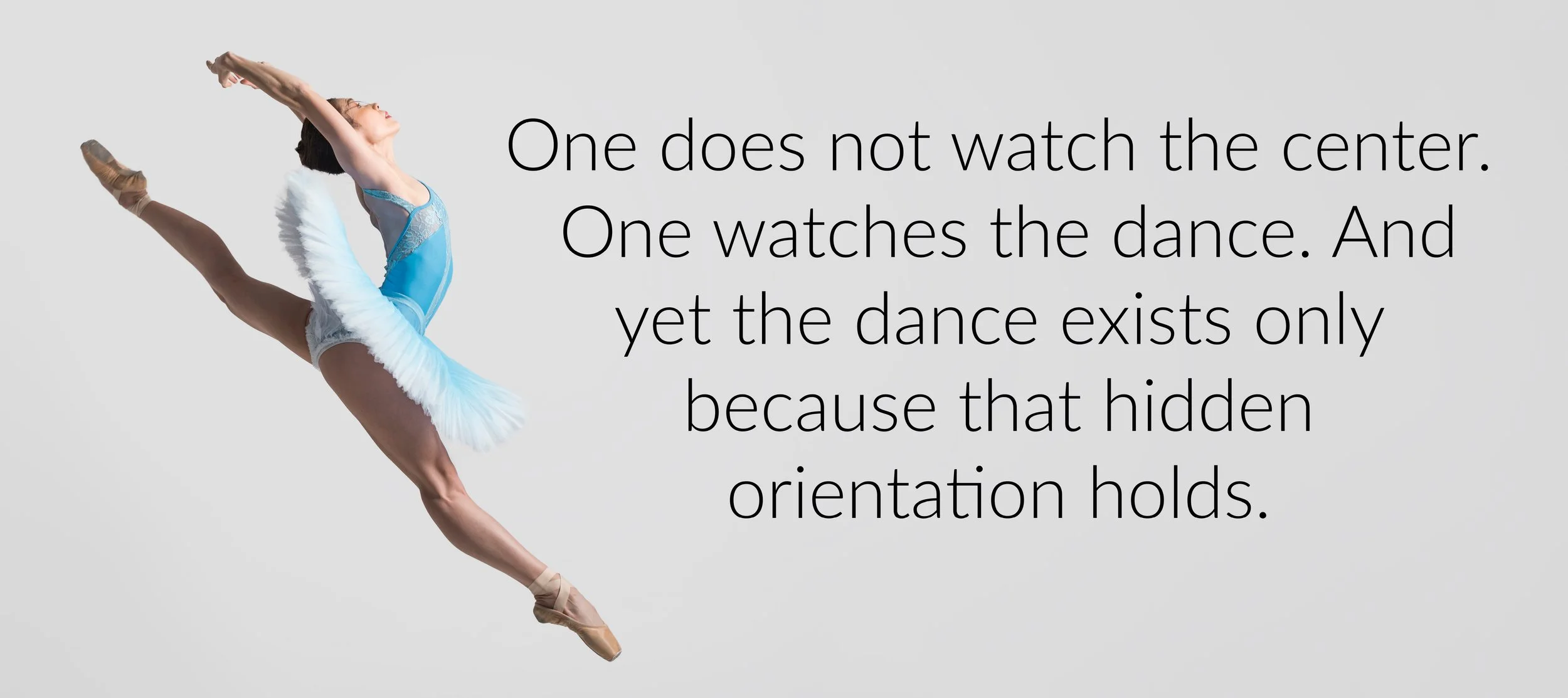
The dance is movement, but the possibility of movement depends upon a still point that does not itself move in the same way. And that center, though vital, does not appear as an object of attention. One does not watch the center. One watches the dance. And yet the dance exists only because that hidden orientation holds.
Beautiful, right?
For Eliot, of course, the metaphor reaches beyond choreography. The “still point” in Four Quartets ultimately gestures toward something theological. Eliot is describing a reality in which the flux of time—past, present, and future—finds its meaning in relation to an eternal presence that is not itself caught within the movement of time.
The world turns, history unfolds, our lives begin and end, but these movements gather around a point that is not simply another moment in the sequence. In Eliot’s Christian imagination, that still point is the presence of God—the eternal center around which the dance of time unfolds.
Thus the dance in Eliot’s poem is not merely the movement of bodies. It is the movement of life itself. The turning world, human history, and the unfolding of experience all become part of the same vast choreography. We do not see the still point directly; we perceive only the dance.
Yet without that center the dance would not exist.
And there is only the dance.
Garth Brooks and John Michael Montgomery sing about this. Terrence Malick films it in The Tree of Life, where the small gestures of ordinary life appear as movements within a vast cosmic choreography.
For the purposes of an aesthetics of dance, Eliot’s insight is valuable for a simple reason. It reminds us that movement alone is not sufficient.
Motion becomes dance only when it is organized, oriented, and held within a structure that allows it to appear as meaningful movement rather than mere activity.
The dancer moves, but the movement remains centered. Without such a center there may still be motion, energy, even spectacle. But there is no dance.
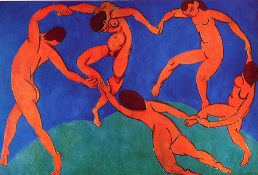
The Dance
by
Henri Matisse
In the essays that follow, we will encounter different ways in which choreographic traditions locate this center. In some cases the organizing principle will be musical form. In others it will be the lived experience of the body, the unfolding of narrative time, or the reciprocal tension between opposing figures occupying the same space.
Each of these traditions, in its own way, answers the same fundamental questions we have begun to ask: What is this movement doing? Why does this movement matter? What holds the movement together?
Eliot’s image of the still point reminds us that wherever dance occurs, some such center must be present—even if it remains invisible to the eye.
For without the still point, there would be no dance.
And yet, as Eliot suggests, what we finally perceive is only the dance.